Best Thunderbolt 4 & USB4 Docks (2026): CalDigit TS5, OWC, Plugable, Anker Compared
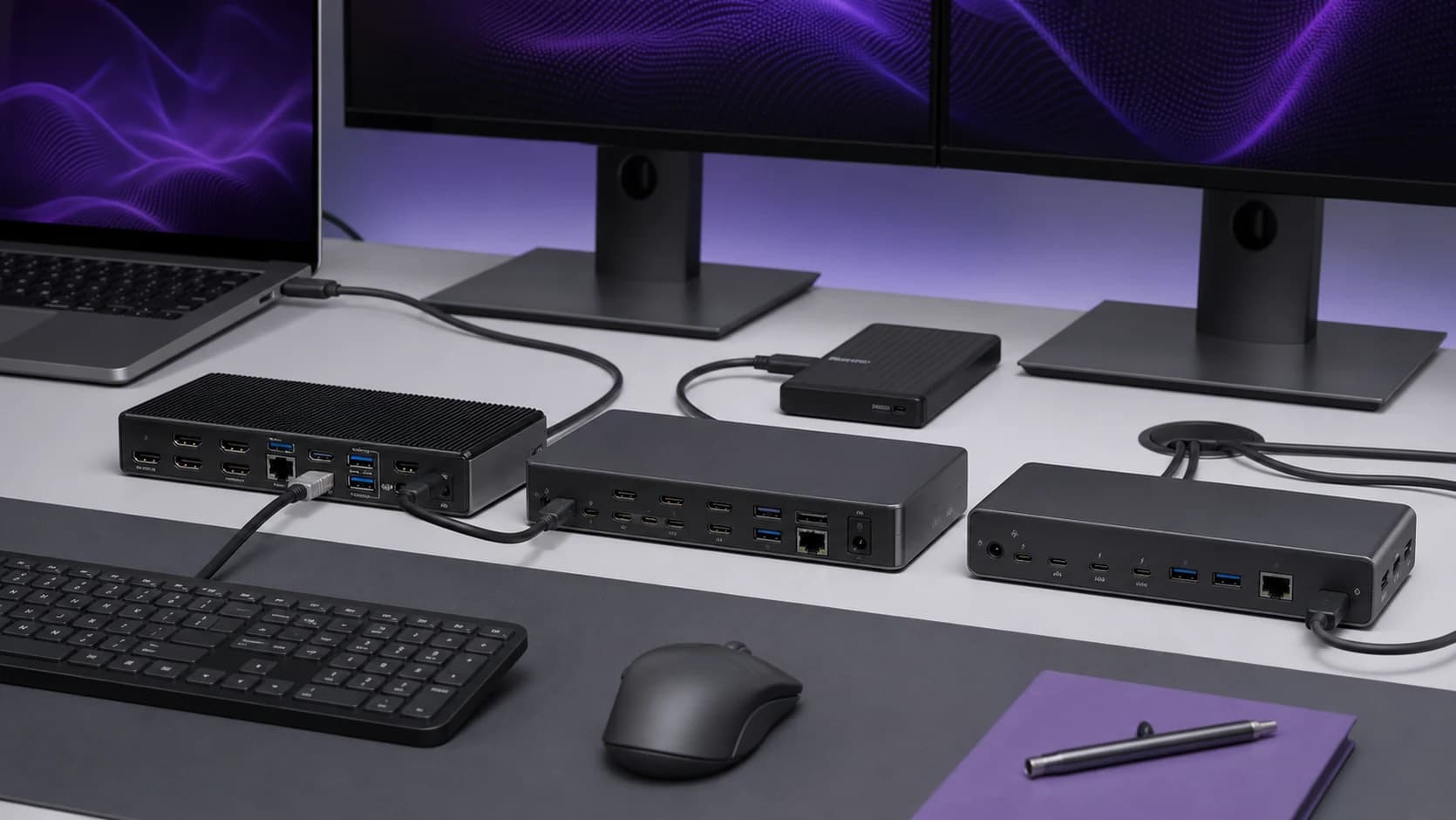
Updated May 2026. Thunderbolt docks aren't fancy USB hubs — you're paying for stability and real bandwidth. Six docks actually worth buying for MacBook and Windows in 2026, with honest notes on dual-display limits, drive performance, and the firmware bugs nobody warns you about.
Editorial evidence review
Recommendations are checked against product documentation, availability, comparative evidence, and clearly disclosed hands-on work where it exists.
Quick picks
The short answer, with the trade-off
Best overall
CalDigit TS4 Thunderbolt 4 Dock
18 ports including 3 TB4
Trade-off: Higher price

Best value
Kensington SD5780T Thunderbolt 4 Dual 4K Dock
Trade-off: Plastic faceplates
Best USB4 for compatible Windows PCs
Plugable USB4 Dual HDMI Docking Station (UD-4VPD)
Trade-off: Plugable marks macOS unsupported

Best for power users
Sonnet Echo 20 Thunderbolt 4 SuperDock
Trade-off: Bulkier design
On this page
- SolderMag Take: docks are an anti‑chaos purchase (and the cheap ones sell chaos)
- Thunderbolt 4 vs USB4: what the labels don’t tell you
- What matters (the stuff you actually feel day-to-day)
- The “buying decision” checklist
- Red flags (skip these docks / listings)
- Setup tips that prevent 80% of dock misery
- Our top picks
- Sources
Thunderbolt 4 / USB4 docks are where “I just need more ports” turns into “I need my desk to stop being a science experiment.”
If you’ve ever had:
- a monitor that randomly blanks
- an external SSD that disconnects mid‑copy
- a laptop that charges… unless you’re doing anything real
…you’re already in dock territory.
This is a mixed editorial + buying guide: I’m going to tell you what to buy and what the industry doesn’t say out loud.
SolderMag Take: docks are an anti‑chaos purchase (and the cheap ones sell chaos)
The best Thunderbolt dock isn’t “the one with the most ports.” It’s the one that makes your setup boringly reliable:
- one cable to the laptop
- predictable displays
- stable storage
- real charging under load
A good dock feels like nothing is happening.
A bad dock feels like you’re constantly troubleshooting the same three ghosts: bandwidth, power, and firmware. Our desk setup essentials guide covers how a dock fits into the broader workspace picture.
Thunderbolt 4 vs USB4: what the labels don’t tell you
Thunderbolt 4 (TB4)
TB4 is a tighter promise.
In practical buying terms, TB4 gear is more likely to have:
- consistent minimum requirements
- better interoperability
- clearer documentation
USB4
USB4 is a family name.
A USB4 dock can be great. or “USB4” can just mean “supports some USB4 stuff.” The important question is:
- Does it support 40Gbps? (some USB4 devices are 20Gbps)
- Does it support tunneling for DisplayPort/PCIe the way you need?
Buying bias: if you want fewer surprises, prefer a Thunderbolt 4‑certified dock (especially if you’re mixing Mac + Windows gear).
What matters (the stuff you actually feel day-to-day)
1) Displays: Mac vs Windows is the whole game
Two realities:
- Windows laptops often support MST (multi‑stream transport) setups more broadly.
- macOS has stricter behaviour around multi‑display over certain paths, and Apple Silicon models vary by external display support.
So when a listing says “dual 4K,” you must ask: dual 4K on what laptop, on what OS, in what mode?
Rule of thumb:
- If you’re on a Mac and “two external monitors” is non‑negotiable, use our Mac dual-monitor dock checklist and verify your specific model's native support first. A dock cannot override hard limits.
2) Bandwidth: your dock is a traffic intersection
A TB4 link has a lot of bandwidth. until you stack:
- two high‑res displays
- a fast NVMe enclosure
- 2.5GbE
- a webcam + audio interface
That’s when cheap docks show their character.
Practical advice: if you plan to run fast storage, keep one downstream Thunderbolt port free for it rather than hoping a random USB‑C port behaves like TB.
3) Charging: “100W PD” isn’t the same as “100W to your laptop”
Dock pages love quoting big PD numbers.
What you care about:
- host charging (what your laptop actually receives)
If you use a 14-16" laptop under load, a dock that only delivers 60W to host can feel like it’s “charging” while still slowly draining.
Buying tip: look for explicit “to host” wattage (90W+ is the comfortable zone for many setups).
4) Port layout: front ports matter more than you think
This is quietly the biggest quality-of-life difference between docks.
Look for:
- a front USB‑C for quick plug‑ins
- an accessible audio port if you use wired headphones
- a front USB‑A if you still live in USB‑A world
Rear‑only ports are fine if your desk is permanently wired. Otherwise, they’re just friction.
5) Ethernet: 1GbE is okay, 2.5GbE is “future calm”
If your internet is fast and you move files on a NAS, 2.5GbE is one of those upgrades you notice immediately.
If Ethernet is the only missing port, compare a dedicated USB-C 2.5GbE adapter before paying for a full Thunderbolt dock.
But don’t overpay for it if:
- your network gear is all gigabit
- you never transfer large files locally
The “buying decision” checklist
Answer these quickly; your dock category will reveal itself.
-
Do you need two external displays?
- No / one display → most TB4 docks will be fine
- Yes → verify laptop + OS support first, then buy based on documented behaviour
-
Are you plugging in fast storage (NVMe enclosures)?
- Yes → prioritize a dock with at least one downstream TB4 port
-
Do you need real charging under load?
- Yes → target 90-100W to host
-
Is your desk mostly permanent cabling?
- Yes → rear ports are fine
- No → you want usable front ports
-
Do you care about wired networking?
- Sometimes → gigabit is fine
- Yes (NAS / big file moves) → 2.5GbE is worth it
Red flags (skip these docks / listings)
- No clarity on USB4 speed (20Gbps vs 40Gbps not stated)
- “Dual display” with zero OS caveats (especially vague about macOS)
- No mention of firmware/updates (docks are computers; updates matter)
- Host charging not specified (“100W PD” but no “to host” number)
- Lots of reviews about sleep/wake issues (classic dock pain)
- Ports described as “USB‑C” without stating data speed (10Gbps? 5Gbps? charge‑only?)
Setup tips that prevent 80% of dock misery
- Use the included Thunderbolt cable (or a certified replacement). Cable quality matters more here than with basic USB.
- If your dock supports it, update dock firmware before you troubleshoot anything else.
- For display issues:
- try a different port path (DP vs HDMI)
- swap the cable first (it’s boring, but it’s real)
- disable “deep sleep” options on the dock if available
- For intermittent SSD disconnects:
- avoid bus‑powered stacks (dock + enclosure + hubs) when possible
- plug high‑draw devices into ports that are documented for higher power
Our top picks
CalDigit TS4 Thunderbolt 4 Dock
Why it works
- 18 ports including 3 TB4
- 98W charging
- Dual 6K or 8K display support
Main trade-off
- Higher price

Kensington SD5780T Thunderbolt 4 Dual 4K Dock
Why it works
- 96W charging
- Dual TB4 downstream
- Solid build with 3-year warranty
Main trade-off
- Plastic faceplates
Plugable USB4 Dual HDMI Docking Station (UD-4VPD)
A dual-HDMI option for Windows buyers whose exact host appears in Plugable's compatibility guidance.
Why it works
- Two built-in HDMI outputs
- Up to 100W host charging
- 2.5GbE plus card readers
Main trade-off
- Plugable marks macOS unsupported
- No downstream Thunderbolt ports

Sonnet Echo 20 Thunderbolt 4 SuperDock
Why it works
- 20 ports total
- Excellent multi-display
- High power delivery
Main trade-off
- Bulkier design
Sources
- Intel Thunderbolt 4 overview + certification requirements (what TB4 guarantees)
- USB-IF materials on USB4 capabilities and versioning terminology
- Apple Support: external display support by Mac model (model-dependent limits)
- VESA DisplayPort documentation (refresh rates, DP modes, and why cables matter)
If your setup is more “portable workstation” than “desk,” also see: Best USB-C hubs for MacBook (2026). hubs are fine when you keep expectations honest. If you are deciding whether the newer standard is worth paying for, read Best Thunderbolt 5 Docks. For head-to-head decisions, see CalDigit TS4 vs Plugable UD-4VPD and CalDigit TS5 vs OWC Thunderbolt 5 Hub. And make sure you pair any dock with a proper cable and a quality 4K monitor to complete the setup.