Anker Nano 75W Car Charger Review: Tidy, With Limits
The Anker Nano 75W keeps a 45W USB-C cable in the car, but that cable is not replaceable. Here is who should buy it and who needs more power.
Research-based review
Recommendations are checked against product documentation, availability, comparative evidence, and clearly disclosed hands-on work where it exists.
Quick picks
The short answer, with the trade-off
Best tidy setup
Anker Nano 75W Car Charger (A2738)
Built-in retractable USB-C cable up to 45W
Trade-off: Built-in cable is not separately replaceable

Better with replaceable cables
Anker 535 Car Charger (67W)
Trade-off: Loose cables need managing

Better for a 90W or 100W laptop
UGREEN 130W USB-C Car Charger
Trade-off: No built-in cable management
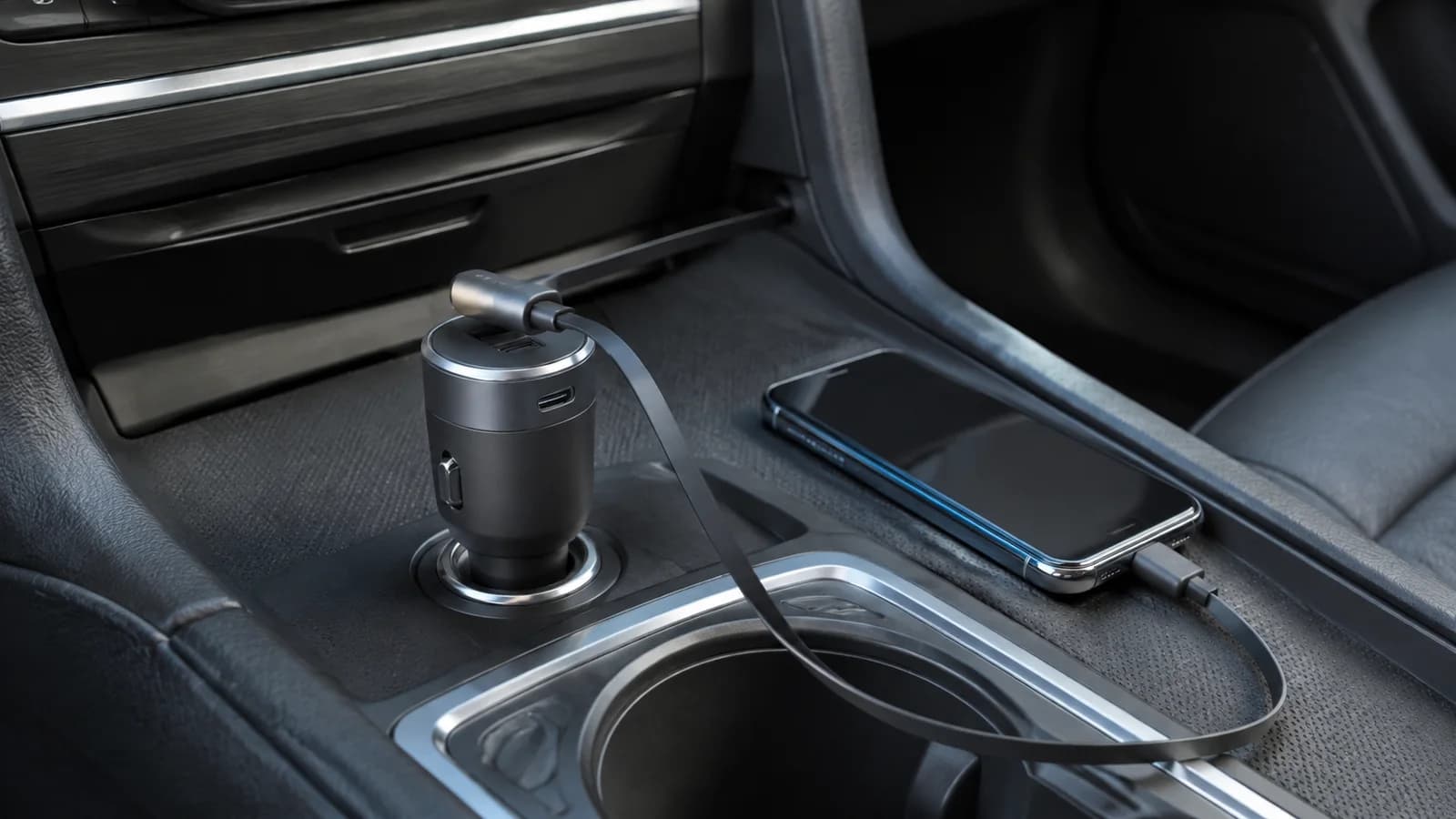
The Anker Nano 75W Car Charger is a good answer to cable clutter, not a high-power laptop charger. Model A2738 combines a built-in retractable USB-C cable rated up to 45W with a separate USB-C port rated up to 30W. Both can run at their full documented limits together for 75W total.
The cable is the reason to buy it and the reason to hesitate. It stays in the car, retracts into the charger, and cannot wander into somebody else's bag. If it is damaged, however, that 45W connection cannot be replaced like an ordinary cable. The remaining port still works, but only up to 30W.
This is a research-based review. SolderMag has not completed hands-on charging, temperature, vehicle-fit, vibration, cable-cycle, drop, or long-term reliability testing. The verdict is based on Anker's current A2738 product information, the published output profiles, an independent teardown, exact US Amazon product identity, and comparison with nearby car chargers.
Verdict
Buy the Anker Nano 75W if you want a cable permanently available in the car and your main device is a phone, tablet, handheld, power bank, or light USB-C laptop. The 45W cable plus 30W port is a practical driver-and-passenger split, and neither connection has to slow down just because the other is occupied.
Skip it if a 65W-to-100W laptop is the priority, you still need USB-A, or you expect to keep the charger after its built-in cable wears out. A separate-cable model is less tidy but easier to repair one part at a time.
Anker Nano 75W Car Charger (A2738)
Buy it for the retractable 45W cable and independent 30W port. Skip it when laptop output or cable replacement matters more than a clean console.
Why it works
- Built-in retractable USB-C cable up to 45W
- Separate USB-C port up to 30W
- Both outputs retain their documented maximum together
Main trade-off
- Built-in cable is not separately replaceable
- No USB-A port
- 45W is below many laptop adapters
Who it is for
The Nano 75W makes sense for:
- drivers who are tired of a loose cable falling between seats;
- households where the car cable keeps leaving in somebody's backpack;
- one phone plus a passenger phone or tablet;
- a Steam Deck-class handheld, camera, or power bank that can use a 30W-to-45W USB-C source;
- a MacBook Air-class or similar laptop that only needs a steady top-up during a drive;
- 12V or 24V vehicles with an accessible accessory socket and enough space around it.
This is a convenience-first charger. It removes one cable-management job while still leaving an open USB-C port for a second device.
Who should skip it
Skip the A2738 if:
- the laptop's normal adapter is 65W, 90W, 100W, 140W, or proprietary and you need equivalent power in the car;
- you want one charger for three devices;
- an older dash cam, watch cable, or passenger accessory still needs USB-A;
- the accessory socket is recessed, loose, or positioned where this wider top could interfere with controls;
- a replaceable cable matters more than a tidy console;
- you want measured thermal or long-term cable data that SolderMag has not produced.
The Anker 535 Car Charger review covers a separate-cable 2C1A alternative. The UGREEN 130W review covers the stronger laptop option.
If you need the retractable cable to run wired CarPlay or Android Auto, this is the wrong connection: it leads to a power adapter, not the infotainment system. Check our CarPlay and car charger compatibility guide before choosing between the car's data port and separate charging with wireless projection.
Key specifications
| Feature | Anker Nano 75W A2738 | What it means |
|---|---|---|
| Vehicle input | 12V/8A or 24V/4A on the inspected product label | Designed for ordinary 12V and 24V accessory sockets; physical fit still varies |
| Built-in connection | Retractable USB-C cable, up to 45W | The fastest output is permanently attached |
| Open connection | 1 × USB-C port, up to 30W | Add a second device with your own USB-C cable |
| Total output | Up to 75W | 45W cable plus 30W port |
| Cable output profiles | 5V/3A, 9V/3A, 12V/3A, 15V/3A, 20V/2.25A | 45W requires a compatible device and profile |
| Cable PPS | 5–11V/3A, up to 30W | Useful for compatible phones; not proof of every branded fast-charging mode |
| Port output profiles | 5V/3A, 9V/3A, 12V/2.5A, 15V/2A | The open port tops out at 30W |
| Approximate cable length | About 0.7–0.75m / 2.3–2.5ft | Enough for a front-seat console, not a rear-seat run |
| Model | A2738 | Check the exact retailer listing |
| Amazon US identity checked | ASIN B0D9NPDLG3 | Exact product link used on this page |
These are supported profiles, not measured charging rates. The connected device, battery state, temperature, vehicle socket, software, and active workload decide what is actually drawn.
How the 45W plus 30W split works
Many multiport chargers advertise a large total and then reduce the main port as soon as a second device is connected. Anker's documented arrangement is easier to understand: the retractable cable is a 45W path and the open USB-C port is a 30W path. An independent teardown also found two separate buck-boost power stages, which is consistent with the two outputs operating independently.
That makes the Nano useful for combinations such as:
- a 30W phone on the open port and a tablet on the built-in cable;
- a handheld or power bank on the 45W cable and a passenger phone on the 30W port;
- a light USB-C laptop on the cable and a phone on the port;
- two phones without one connection falling to an old slow-charging rate.
Neither output provides 75W on its own. The large number is the sum of 45W and 30W. Connecting a 65W laptop to the built-in cable does not make that cable exceed 45W.
The USB-C charger wattage guide explains the negotiation step. A charger offers profiles; the device chooses a compatible one. Headline wattage is a ceiling, not a constant push into every device.
The retractable cable: useful, but not serviceable
The retractable cable solves three ordinary problems. It is always in the car, it stores without a loose coil around the cup holder, and it frees the open port for a passenger or second device.
The mechanism also adds parts that a fixed-port charger does not need. There is a spool, contact system, flat cable, spring or bearing mechanism, and a USB-C connector that will be pulled and returned repeatedly. ChargerLAB's teardown found a cushioned cable module and multiple current-carrying contacts, but component construction is not the same as a long-term durability result.
We have not cycled the cable thousands of times, left it through a summer in a parked car, filled the mechanism with dust, or tested how it behaves after repeated sideways pulls. Manufacturer cycle claims can describe a controlled test; they do not guarantee the same result in every console.
Treat the cable gently:
- Pull it straight rather than sideways across a sharp console edge.
- Do not let the connector snap back into the body.
- Keep the cable away from seat rails, shifters, pedals, and cup-holder hinges.
- Stop using it if the connector becomes loose, the jacket splits, or charging repeatedly cuts out.
- Use the open USB-C port with a known-good cable if the built-in lead becomes suspect.
Our USB-C cable guide covers damage, power ratings, and the signs that a cable should be retired. The difference here is that retiring the built-in cable also removes the charger's fastest connection.
What it can charge well
Phones
The Nano has ample paper capacity for current iPhones and many Android phones. A phone will request an available USB-C PD or PPS profile rather than take 45W simply because the cable can provide it.
Put the phone on either connection. Use the retractable cable for the cleanest daily setup, or leave it for a tablet or handheld and connect the phone to the 30W port.
Do not assume that PPS guarantees a manufacturer's fastest advertised mode. Phone model, firmware, cable path, voltage range, and temperature still matter.
Tablets, handhelds, and power banks
This is the charger's strongest use case. Many tablets, handheld gaming PCs, cameras, and medium power banks benefit from 30W to 45W without requiring a 100W source.
Put the higher-demand device on the 45W cable. A passenger phone can use the separate 30W port without taking power from that connection.
Laptops
A 45W source can charge many USB-C laptops, but the result depends on the computer and workload. Check the wattage on the original adapter:
- 30W to 45W adapter: close paper match, assuming compatible USB-C input;
- 60W to 67W adapter: useful for light work or topping up, but below the original power budget;
- 90W to 100W adapter: likely too slow to replace the normal charger under load;
- 140W or proprietary adapter: choose a different car-power setup.
A laptop compiling code, rendering video, gaming, or driving peripherals may consume more than it receives from a 45W cable. In that case the battery can charge slowly, hold steady, or continue to fall.
Vehicle fit, heat, and setup
The product is designed around a vehicle accessory socket, but socket depth, angle, spring tension, and surrounding trim vary. Product dimensions cannot prove it will clear every shifter, cup holder, sliding cover, or dashboard ledge.
Before relying on it for a trip:
- Seat the charger firmly with the vehicle parked.
- Extend the cable only as far as needed.
- Confirm the cable cannot reach the pedals or steering controls.
- Connect the priority device to the 45W cable.
- Add the second device to the open USB-C port.
- Watch for resets, loose contact, damaged trim, unusual smells, or excessive heat.
- Check whether the accessory socket stays powered after the ignition is off.
Anker identifies temperature monitoring as part of the product's safety system. That is a manufacturer feature, not evidence that SolderMag measured sustained 75W operation in a closed, sun-heated cabin. Reduce the load and investigate if the charger repeatedly cuts out as the interior warms.
Value
The Nano is worth considering when the retractable cable prevents a real daily annoyance. It can replace a separate charger and one loose cable while still supporting a second USB-C device.
It is weak value when the built-in cable is merely novel. A conventional charger can offer more ports, higher single-port output, or easier repair for similar money depending on the current market. Compare today's price with the Anker 535 and UGREEN 130W, then choose from the charging job rather than the total printed on the box.
We would pay a modest premium for the Nano over a reputable two-port phone charger if the cable will stay in the vehicle and be used most days. We would not pay extra when a 65W laptop, USB-A accessory, or rear-seat cable run is the real requirement.
Alternatives
Anker 535 Car Charger (67W)
Choose the Anker 535 when replaceable cables, three physical ports, and USB-A matter. Either USB-C port can provide up to 67W in the appropriate single-port mode, which gives a lighter laptop more headroom than the Nano's 45W cable.
The compromise is power sharing. With all three connections occupied, the 535's secondary ports fall to slow top-up levels. Read the Anker 535 review for the exact allocation.

Anker 535 Car Charger (67W)
Why it works
- Up to 67W from a USB-C port when used alone
- Two USB-C ports plus USB-A
- Damaged cables can be replaced
Main trade-off
- Loose cables need managing
- Secondary ports slow down in three-device use
UGREEN 130W USB-C Car Charger
Choose the UGREEN when a 90W-to-100W laptop is the main reason for buying a car charger. Its primary USB-C connection is rated up to 100W, and it keeps two additional ports for a phone or accessory.
It is more charger than a phone-only buyer needs, and it does not solve cable storage. The UGREEN 130W review explains the vehicle, cable, and port checks before using that higher output.

UGREEN 130W USB-C Car Charger
Why it works
- Primary USB-C port up to 100W
- Two USB-C ports plus USB-A
- More useful for laptop-first trips
Main trade-off
- No built-in cable management
- Unnecessary output for phone-only charging
The best USB-C car chargers guide compares these with simpler phone-first options.
Common mistakes
Reading 75W as one-port output. The total is 45W from the cable plus 30W from the port.
Buying it for a 100W laptop. The built-in cable stops at 45W.
Assuming the cable is replaceable. It is part of the charger. The open 30W port remains useful if the cable fails, but the fastest path is lost.
Forgetting USB-A devices. There is no USB-A port.
Expecting the cable to reach the rear seat. Roughly 0.7m is intended for the front console area.
Ignoring socket placement. A suitable electrical specification does not guarantee clearance around every vehicle console.
FAQ
Is the Anker Nano 75W Car Charger worth it?
It is worth considering when a retractable cable will be used frequently and 45W plus 30W matches the two devices in the car. It is not the sensible choice for a 65W-to-100W primary laptop or for buyers who want every cable replaceable.
Can it charge a MacBook?
It can charge USB-C MacBooks that accept one of its supported profiles, up to the built-in cable's 45W limit. A MacBook Air-class device is a more realistic fit than a high-power MacBook Pro under load. Check the exact computer's normal adapter and USB-C charging support.
Does either connection provide the full 75W?
No. The built-in cable is rated up to 45W and the separate USB-C port up to 30W. The two maximums add to 75W.
How long is the retractable cable?
Published and independently inspected examples place it at roughly 0.7–0.75m, or about 2.3–2.5ft. That suits a front-seat console but is not a rear-seat extension cable.
Can the built-in cable be replaced?
Not as a normal user-replaceable lead. If it becomes damaged, the separate 30W USB-C port can still take an ordinary cable, but the 45W built-in path is no longer a practical advantage.
Does it work in 12V and 24V vehicles?
The inspected A2738 label lists 12V and 24V input. Check the vehicle manual, socket condition, and physical clearance before use; voltage compatibility does not guarantee fit in every console.
Can it fast-charge two phones at once?
It provides a 45W cable and 30W port concurrently, which is enough paper capacity for many two-phone combinations. The exact rate depends on each phone's supported USB-C PD or PPS profiles, software, battery state, and temperature.
Final recommendation
Buy the Anker Nano 75W Car Charger when a tidy front-seat setup matters more than maximum laptop power. The independent 45W cable and 30W port are a sensible phone-plus-tablet, phone-plus-handheld, or light-laptop-plus-phone arrangement.
Skip it when the main computer normally needs 65W or more, USB-A is still important, or you plan to keep the charger longer than you trust an integrated cable. The Anker 535 is easier to service with ordinary cables; the UGREEN 130W is the better laptop tool.
Sources and methodology
- Anker official A2738 US product page for current model identity, total-output positioning, dual-device design, and retractable-cable purpose.
- Anker official A2738 regional product page for the 45W cable, 30W USB-C port, approximate cable length, and manufacturer-described temperature monitoring.
- ChargerLAB A2738 teardown and label inspection for input/output profiles, measured physical dimensions, cable length, and internal dual-power-stage construction.
- Anker official 535 Car Charger product page and UGREEN official 130W Car Charger product page for alternative layouts and output limits.
- Amazon Creators API exact-product validation for Anker Nano 75W
B0D9NPDLG3, Anker 535B0BSVB93DK, and UGREEN 130WB0B3CSLPZRin the US marketplace with the configuredsoldermag-20Associate tag.
Product identity, supported power profiles, connector layout, cable design, and documented input were checked against current sources. Price, featured offer, seller, socket fit, sustained output, real charging speed, temperature, cable wear, vibration tolerance, and long-term reliability remain unverified unless explicitly stated otherwise.
As an Amazon Associate I earn from qualifying purchases.