Best USB-C Car Chargers (2026): Phone and Laptop Picks
Compare Anker, UGREEN and Belkin USB-C car chargers by port power, cable design and device fit. Find the right pick for a phone, tablet or laptop.
Research-based buying guide
Recommendations are checked against product documentation, availability, comparative evidence, and clearly disclosed hands-on work where it exists.
Quick picks
The short answer, with the trade-off
Best overall
Anker 535 Car Charger (67W)
Up to 67W from the main USB-C port
Trade-off: Loose cables still need managing

Best for laptops
UGREEN 130W USB-C Car Charger
Trade-off: More charger than phone-only buyers need

Best tidy setup
Anker Nano Retractable USB-C Car Charger (75W)
Trade-off: Built-in cable is not replaceable

Best simple phone charger
Belkin BoostCharge 37W Dual Car Charger
Trade-off: Not a laptop charger
On this page
- Who this is for
- What matters in a USB-C car charger
- Best overall: Anker 535 Car Charger (67W)
- Best for laptops: UGREEN 130W USB-C Car Charger
- Best tidy setup: Anker Nano Retractable USB-C Car Charger (75W)
- Best simple phone charger: Belkin BoostCharge 37W Dual Car Charger
- Best certified option: Nekteck 45W USB-C Car Charger
- What about 60W dual USB-C chargers?
- Buying checklist
- Common mistakes
- Final recommendation
- FAQ
- Sources and methodology
If your car's built-in USB port cannot keep up with your phone or laptop, check its documented output before buying another charger. A port that supports CarPlay does not necessarily provide the USB-C Power Delivery profile your device needs.
The fix is simple: use the 12V socket for a proper USB-C Power Delivery car charger. The mistake is buying the highest printed wattage and assuming the car, cable, and charger will all behave like a wall outlet.
This is a research-based buying guide. We have not completed bench testing on every model below, so the picks are based on published specifications, product availability, safety/certification signals where available, port layout, current buyer fit, and how each charger maps to real in-car use.
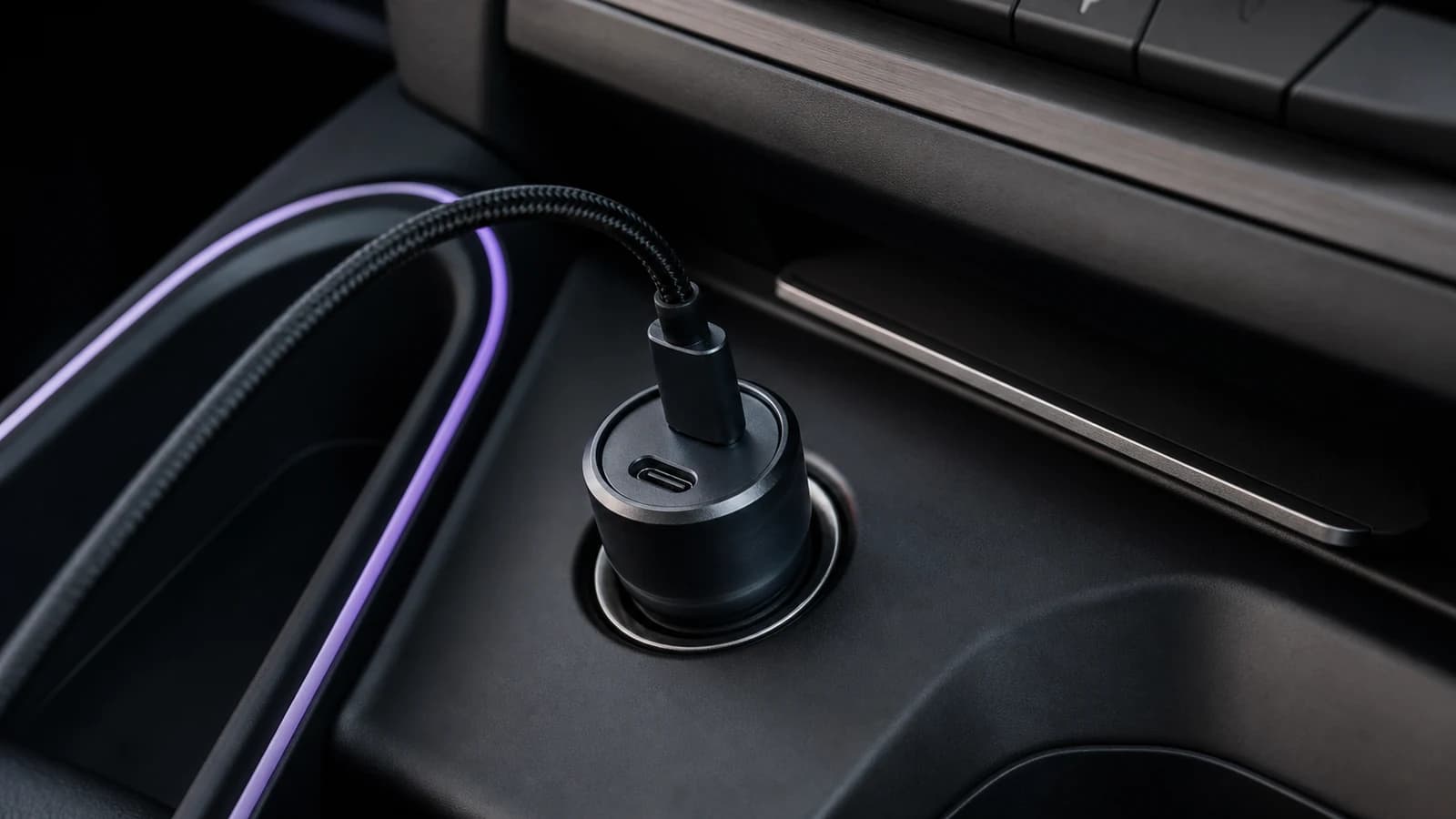
Quick answer: the Anker 535 Car Charger is the practical default for mixed-device use because it gives you two USB-C ports, one USB-A port, and up to 67W from the primary USB-C port when used alone. Pick the UGREEN 130W if you need a higher-output laptop port. Pick the Anker Nano 75W if a built-in retractable cable matters more than maximum output.
Who this is for
Buy a USB-C car charger if you:
- drive an older car with weak USB-A ports
- need fast phone charging during short trips
- run CarPlay or Android Auto and still want net battery gain
- travel with a tablet, handheld gaming PC, camera battery, or small USB-C laptop
- want one charger that covers the driver and passenger without a glove-box cable nest
Skip it if your car already has high-wattage USB-C PD ports and those ports meet your device's wattage needs. Some newer cars do this properly. Many do not.
What matters in a USB-C car charger
1) Per-port wattage, not total wattage
"130W total" sounds better than "67W" until you read the split. A charger can advertise a big total number while giving the useful port much less power once a passenger plugs in.
For phones, 20W to 30W is enough. For iPads and handhelds, 30W to 45W is more comfortable. For laptop top-ups, look for a main USB-C port rated for 65W or more, and ideally 100W if you expect to charge while using the laptop.
2) PPS support for Samsung and modern Android phones
USB Power Delivery is the baseline. PPS is the nice-to-have that lets compatible devices request more precise voltage/current steps. USB-IF says certified fast chargers support PPS under the USB PD 3.0 fast-charging program, and Belkin describes PPS as dynamically adjusting output for the connected device.
Practical translation: iPhone buyers mostly need USB-C PD. Samsung Galaxy buyers should care more about PPS.
3) A real cable
The charger cannot do the job if the cable is the bottleneck. For phone-only use, most USB-C cables are fine. For laptop-class charging, use a 60W, 100W, or 240W USB-C cable that is actually rated for the power you expect. Our USB-C cable guide covers the failure modes.
4) Heat and fit
A car charger sits in a hot dashboard, gets bumped by bags and knees, and has to deal with the messier electrical environment of a vehicle. Avoid mystery-brand chargers that promise huge output, six ports, and no meaningful safety details. A lower-wattage charger from a known brand is a better bet than a fake 200W cylinder from a listing you cannot trace next month.
Best overall: Anker 535 Car Charger (67W)
Buy this if: you want one compact charger for the driver, passenger, and a third accessory without overthinking the port split.
Anker's 535 is the boring pick in the right way. The primary USB-C port can deliver up to 67W, and the charger has two USB-C ports plus one USB-A port. That covers a modern iPhone or Galaxy, a passenger phone, and an older cable for someone who still has USB-A in the bag.
The reason it is the default pick is balance. It is not trying to run two laptops at once. It is not tied to a built-in cable. It gives most buyers enough output to fast-charge a phone, charge a tablet, or meaningfully top up a MacBook Air on a longer drive.
Our Anker 535 Car Charger review explains the exact 67W single-port mode, the 45W + 9W + 9W three-device split, cable requirements, vehicle fit, and who should choose a higher-output model instead.
The trade-off is cable clutter. If your car already has too many loose cables, the retractable Anker Nano below may make more sense.
Anker 535 Car Charger (67W)
Why it works
- Up to 67W from the main USB-C port
- Two USB-C ports plus one USB-A port
- Good fit for mixed phone, tablet, and light laptop use
Main trade-off
- Loose cables still need managing
- Not the highest-output option for laptop-heavy trips
Best for laptops: UGREEN 130W USB-C Car Charger
Buy this if: you want the car charger to handle a MacBook Air, iPad Pro, USB-C handheld, or emergency laptop top-up.
The UGREEN 130W is the power pick. UGREEN lists it as a three-port charger with two USB-C ports and one USB-A port, with up to 100W from the main USB-C port and 130W total output. That is the key difference: it can act like a real laptop charger from the 12V socket instead of merely slowing battery drain.
Our UGREEN 130W review covers the exact port layout, laptop fit, cable requirements, and vehicle-socket checks. If these are your final two options, the Anker 535 vs UGREEN 130W comparison maps both chargers to phone, tablet, and laptop use.
This is the better choice for road trips, field work, photographers, mobile developers, and anyone who keeps a USB-C laptop in the car. It also pairs well with a larger USB-C power bank: charge the bank from the car between stops, then use the bank away from the vehicle.
Do not buy it just for an iPhone. A phone will not charge faster because the charger can output 130W. You are paying for headroom.

UGREEN 130W USB-C Car Charger
Why it works
- Up to 100W from the main USB-C port
- Three-port layout for laptop plus phone accessories
- Useful for road trips and mobile work
Main trade-off
- More charger than phone-only buyers need
- Check the port split before using multiple devices
Best tidy setup: Anker Nano Retractable USB-C Car Charger (75W)
Buy this if: your main problem is cable mess, not maximum wattage.
The Anker Nano retractable charger is a smart answer to the old-car problem: it adds a built-in USB-C cable rated up to 45W and a second USB-C port rated up to 30W. The total output is up to 75W, which is enough for a phone plus tablet, or a light laptop top-up from the built-in cable while another device uses the open port.
The built-in cable is the point. It keeps the charger in the car, keeps the cable from wandering into someone else's backpack, and makes short trips less annoying.
The catch is obvious: if the retractable cable fails, you cannot simply swap that part. Buy this for convenience, not because it is the most serviceable design.
Our Anker Nano 75W Car Charger review covers the exact 45W-plus-30W split, laptop limits, socket checks, and the long-term trade-off of a non-replaceable cable.

Anker Nano Retractable USB-C Car Charger (75W)
Why it works
- Built-in retractable USB-C cable
- 45W cable plus 30W USB-C port
- Good for older cars without built-in USB-C
Main trade-off
- Built-in cable is not replaceable
- Lower laptop headroom than the UGREEN 130W
Best simple phone charger: Belkin BoostCharge 37W Dual Car Charger
Buy this if: you mostly charge phones and want a compact, mainstream option.
Belkin's 37W dual charger is not exciting, which is fine. It gives you a 25W USB-C port and a 12W USB-A port. Belkin also lists USB-C PD 3.0 and PPS support for compatible devices.
This is a good fit for one modern phone plus one older accessory. It is also a sensible choice for a second car, rideshare use, or anyone who does not need to charge a laptop from the dashboard.
Skip it if you want to run an iPad, handheld console, or laptop at meaningful speed. The USB-C port is phone-class output.

Belkin BoostCharge 37W Dual Car Charger
Why it works
- 25W USB-C plus 12W USB-A
- Compact mainstream option
- PPS support for compatible phones
Main trade-off
- Not a laptop charger
- Only one USB-C port
Best certified option: Nekteck 45W USB-C Car Charger
Buy this if: USB-IF certification matters more to you than maximum output.
The Nekteck 45W model is a useful conservative pick because the Amazon listing identifies it as USB-IF certified, with USB-C PD 3.0 plus USB-A output. It is not as slick as the newer Anker and UGREEN options, but 45W is still enough for fast phone charging, tablets, and light laptop top-ups.
This is the charger we would consider for someone who wants fewer marketing fireworks and more standards confidence. The downside is that it looks and feels like an older generation product.

Nekteck 45W USB-C Car Charger
Why it works
- USB-IF-certified listing
- 45W USB-C PD output
- Includes a practical phone/tablet power tier
Main trade-off
- Less total output than newer multi-port chargers
- Older design
What about 60W dual USB-C chargers?
Scosche's PowerVolt 60W dual USB-C charger is worth a look if you want two equal USB-C ports instead of one stronger primary port. The Amazon listing describes dual 30W USB-C outputs with PD 3.0 and PPS support. That is excellent for two phones, a phone plus iPad, or two passengers who both want modern USB-C.
We would still pick the Anker 535 for most people because its primary port has more laptop headroom and it keeps a USB-A fallback. But if your car is already all USB-C, dual 30W is cleaner.

Scosche PowerVolt 60W Dual USB-C Car Charger
Why it works
- Two USB-C ports
- 30W per port
- Good passenger-friendly layout
Main trade-off
- No single high-output laptop port
- Less useful if you still need USB-A
Buying checklist
Before you buy, check:
- Main-port output: 20W to 30W for phones, 45W for tablets/light laptops, 65W to 100W for real laptop use.
- Port split: what happens when two or three devices are connected?
- PPS support: more important for Samsung Galaxy than iPhone.
- Cable rating: laptop charging needs a proper USB-C cable, not a mystery cable from the center console.
- Physical fit: some 12V sockets are recessed or angled; huge chargers can block cup holders or shifters.
- Heat: avoid high-wattage no-name chargers with vague safety claims.
- USB-A fallback: still useful for older dash cams, passengers, and emergency cables.
Common mistakes
- Buying 100W for an iPhone only. The phone will pull what it can pull. You are not speeding it up by overbuying.
- Using an old USB-A cable and blaming the charger. If the cable is wrong, the charger cannot negotiate modern USB-C PD.
- Assuming every car socket can sustain high output gracefully. If a charger resets, gets very hot, or disconnects under load, stop using that combination.
- Ignoring cable length. A short cable is fine for the driver. Rear-seat charging needs a longer rated cable or a dedicated rear charger.
- Leaving cheap chargers plugged in forever. If the charger gets hot while idle, replace it.
Final recommendation
Most people should buy the Anker 535 Car Charger. It has enough output for the common phone/tablet/light-laptop mix and a port layout that works in real cars.
Buy the UGREEN 130W if you specifically need laptop-class charging from the 12V socket. Buy the Anker Nano retractable charger if keeping the car tidy is the main goal. Buy the Belkin 37W if all you need is a reliable phone charger for a commute car.
For a full travel charging kit, pair this with our best USB-C travel adapters, best USB-C power banks, and USB-C charger wattage guide.
FAQ
Can a USB-C car charger charge a laptop?
Yes, if the charger has enough USB-C PD output and your cable supports it. For a MacBook Air or similar laptop, 45W to 67W can be useful. For heavier laptops, look for a 100W-capable main port and expect slower charging than a wall adapter if the laptop is under load.
Is PPS necessary for iPhone?
No. iPhones mainly need USB-C Power Delivery. PPS matters more for Samsung Galaxy and some Android devices that use more flexible fast-charging profiles.
Is a 130W car charger safe?
It can be, but buy from a reputable brand and watch heat. A high-output charger in a hot dashboard has less thermal room than a wall charger on a desk. If it gets uncomfortable to touch, resets, or smells hot, stop using it.
Do I need USB-A in 2026?
Not for your main phone, but it is still useful in a car. Passengers, dash cams, older accessories, and emergency cables often still use USB-A.
Sources and methodology
- Anker 535 Car Charger product information: https://www.anker.com/products/b2731
- Amazon listing validation for Anker 535 Car Charger: https://www.amazon.com/dp/B0BSVB93DK?tag=soldermag-20
- UGREEN 130W USB-C Car Charger product information: https://us.ugreen.com/products/ugreen-130w-usb-c-car-charger
- Amazon listing validation for UGREEN 130W USB-C Car Charger: https://www.amazon.com/dp/B0B3CSLPZR?tag=soldermag-20
- Amazon listing validation for Anker Nano Retractable USB-C Car Charger: https://www.amazon.com/dp/B0D9NPDLG3?tag=soldermag-20
- Belkin BoostCharge 37W product information: https://www.belkin.com/p/dual-car-charger-with-pps-37w/CCB004btBK.html
- USB-IF fast charger/PPS certification overview: https://www.usb.org/node/585
- USB-IF certified product search notes: https://www.usb.org/products
As an Amazon Associate I earn from qualifying purchases.