Edifier MR5 vs MR4: Is the Bigger 3-Way Upgrade Worth It?
Choose the Edifier MR5 for a larger 3-way system, XLR, Bluetooth and room controls, or the MR4 for a smaller, simpler wired desk.
Research-based comparison
Recommendations are checked against product documentation, availability, comparative evidence, and clearly disclosed hands-on work where it exists.
Quick picks
The short answer, with the trade-off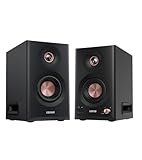
Best for a larger creator desk
Edifier MR5
3-way design with dedicated midrange drivers
Trade-off: Much larger and heavier than MR4

Best value for a compact wired desk
Edifier MR4
Trade-off: No Bluetooth, XLR or app controls
On this page
- Quick answer
- Edifier MR5 vs MR4 comparison
- Who should buy the Edifier MR5?
- Who should buy the Edifier MR4?
- The main upgrade is the 3-way system, not Bluetooth
- Size is the trade-off most buyers will notice
- Inputs: MR5 adds XLR and useful wireless playback
- Room controls: MR5 offers more ways to fix placement
- Published response and power need context
- Price and value
- Alternatives
- Common mistakes
- Frequently asked questions
- Final recommendation
- Sources and methodology
Buy the Edifier MR5 if you have room for a much larger pair and will use its 3-way design, balanced XLR inputs, Bluetooth with LDAC, app controls, or higher published output. Buy the MR4 for a normal computer desk where a compact wired monitor is enough.
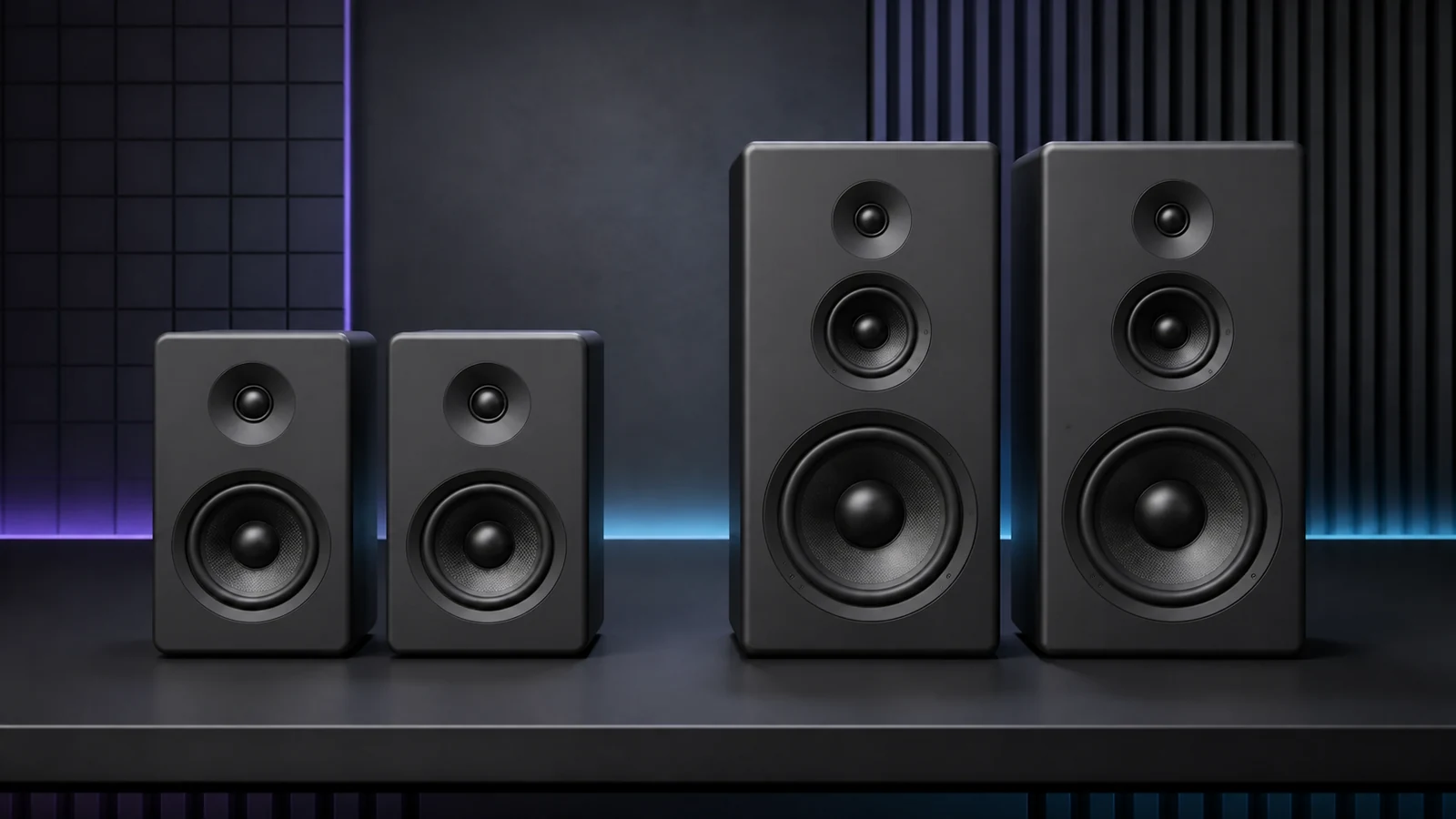
The MR5 is not a small step up. Each cabinet is wider, taller and substantially deeper, and the pair weighs more than twice as much. It adds a dedicated midrange driver, 110W total published RMS output, Bluetooth multipoint, XLR, app-based room controls and a 46Hz–40kHz manufacturer response range. The MR4 is a simpler 42W two-way system with balanced TRS, RCA and AUX inputs.
That specification gap does not prove that the MR5 sounds twice as good. SolderMag has not completed a controlled, level-matched listening test or acoustic measurements of these speakers. This comparison is based on current Edifier specifications, manuals, exact US product identity and the practical cost of each design.
Quick answer
Choose the MR5 when the speakers are a meaningful part of the room rather than accessories squeezed beside a display. Its dedicated 3.75-inch midrange drivers, 5-inch woofers, higher published output, deeper cabinets and room-adjustment tools suit a larger desk, editing suite or small studio where placement can be managed.
Choose the MR4 when you need balanced speakers at arm's reach and do not need Bluetooth, XLR or app controls. It keeps the front headphone socket, balanced TRS inputs and monitor/music modes in cabinets that are easier to place around a normal monitor.
Skip both if you need USB audio, optical input, HDMI ARC or a dedicated subwoofer output. Neither current specification provides those connections.
Edifier MR5 vs MR4 comparison
| Decision | Edifier MR5 | Edifier MR4 | Buying consequence |
|---|---|---|---|
| Speaker design | 3-way, tri-amplified | 2-way | MR5 separates bass, midrange and treble duties |
| Drivers per speaker | 5-inch woofer, 3.75-inch midrange, 1-inch tweeter | 4-inch woofer, 1-inch tweeter | Driver count alone does not prove sound quality |
| Published total output | 110W RMS | 42W RMS | MR5 has more paper headroom; no matched loudness test is claimed |
| Published response | 46Hz–40kHz | 60Hz–20kHz | Edifier does not state one shared tolerance here, so this is not a measured winner |
| Balanced inputs | XLR and 6.35mm TRS | 6.35mm TRS | MR5 supports more studio cabling; both work with a suitable interface |
| Other inputs | RCA, AUX, Bluetooth 6.0 | RCA, AUX | MR5 handles wireless sources without another receiver |
| Bluetooth codecs | LDAC and SBC | No Bluetooth listed | MR5 is the only wireless option |
| App controls | ConneX EQ and room settings | None listed | MR5 exposes more setup adjustment |
| Powered cabinet | 159 × 264 × 280mm | 140 × 228 × 197.5mm | MR5 needs much more depth |
| Pair weight | 10.38kg | 4.5kg | MR5 needs a sturdier desk or stands |
| Headphone output | 3.5mm | 3.5mm | Both can hand the analog path to headphones |
| USB / optical / sub out | None listed | None listed | Neither is a one-cable digital or simple 2.1 system |
Who should buy the Edifier MR5?
Buy the MR5 if:
- you have measured space for 280mm-deep powered cabinets;
- a larger desk or small room needs more published output than the MR4 provides;
- you want separate bass, midrange and treble drivers;
- balanced XLR inputs fit your interface, mixer or monitor controller;
- Bluetooth multipoint is useful for switching between two wireless devices;
- LDAC matters for a compatible Android source;
- app-based low-cut, acoustic-space and desktop controls solve a real placement problem.
The MR5 makes the most sense when several of those points apply. Buying it only because 110 is a larger number than 42 ignores the space, weight and system cost that come with the bigger pair.
Edifier MR5
Choose it for the 3-way design, broader input set and room controls when the larger cabinets fit.
Why it works
- 3-way design with dedicated midrange drivers
- Balanced XLR and TRS plus Bluetooth with LDAC
- App-based room compensation controls
Main trade-off
- Much larger and heavier than MR4
- No USB, optical or dedicated subwoofer output
- Costs more to justify when features go unused
Who should buy the Edifier MR4?
Buy the MR4 if:
- the speakers must fit beside a normal computer monitor;
- every regular source has an analog output;
- balanced TRS is enough for your interface or mixer;
- front AUX and headphone sockets matter more than wireless playback;
- you prefer physical controls without an app;
- the saving can pay for stands, isolation or a better interface.
The MR4 remains the rational entry point for a small creator desk. Its simpler input list is not a problem when one interface stays connected all the time, and the smaller cabinets are easier to position symmetrically.
Edifier MR4
The sensible choice when a compact analog monitor is enough and the MR5's extra hardware would sit unused.
Why it works
- Smaller and lighter cabinets
- Balanced TRS plus RCA and front AUX
- Simple monitor and music modes
Main trade-off
- No Bluetooth, XLR or app controls
- Lower published output
- No USB, optical or dedicated subwoofer output
The main upgrade is the 3-way system, not Bluetooth
The MR4 uses one 4-inch woofer and one 1-inch tweeter in each cabinet. A crossover divides the signal between those two drivers.
The MR5 adds a dedicated 3.75-inch midrange driver between its 5-inch woofer and 1-inch tweeter. Edifier lists crossover points at 155Hz and 2,600Hz, with separate amplification for bass, midrange and treble. On paper, that lets each driver cover a narrower part of the spectrum.
That architecture can be useful, but it is not a listening result. A well-designed two-way speaker can outperform a poorly integrated three-way speaker. A fair verdict would need comparable frequency-response, directivity, distortion and compression measurements plus level-matched listening in the same position.
The safe conclusion is that the MR5 is the more ambitious design. It is the pair to consider when you want a dedicated midrange, greater published output and a cabinet large enough to support the system. The MR4 is the less complicated tool for close listening at moderate levels.
Size is the trade-off most buyers will notice
The MR5 powered cabinet measures 159mm wide, 264mm tall and 280mm deep. The passive cabinet is 257mm deep. The MR4 powered cabinet is 140mm wide, 228mm tall and 197.5mm deep; its passive cabinet is 184mm deep.
The width difference is modest. The depth difference is not. The powered MR5 extends 82.5mm farther back than the powered MR4 before allowing room for cables and rear controls. On a shallow desk, that can push the front baffle too close to the listener or force the cabinet against a wall.
The MR5 pair also weighs 10.38kg compared with 4.5kg for the MR4. Check the desk or stand capacity, especially if the surface already carries a large monitor, desktop PC, arm and other equipment.
Before buying either pair:
- Measure the clear width and depth on both sides of the display.
- Leave access for rear cables and adjustment knobs.
- Keep both speakers at similar distances from walls and corners.
- Place the tweeters near ear height or angle them appropriately.
- Use stable stands or pads if the desk resonates.
- Confirm that the powered-to-passive speaker cable can follow the planned route.
A monitor arm can free more usable space than squeezing larger speakers around wide factory monitor feet.
Inputs: MR5 adds XLR and useful wireless playback
Both models support balanced 6.35mm TRS, unbalanced RCA and 3.5mm AUX. Both also provide a 3.5mm headphone output. That covers an audio interface, mixer, desktop computer with an analog output and ordinary line-level devices.
The MR5 adds balanced XLR. XLR is useful when the rest of the desk already uses professional balanced cabling or when the interface's TRS outputs are needed elsewhere. It does not inherently improve sound over a correctly implemented short balanced TRS connection.
The MR5 also adds Bluetooth 6.0 with SBC, LDAC and multipoint connection. Edifier says two devices can remain connected. That is convenient for a computer-and-phone desk, but Bluetooth should not be treated as the editing path. Codec support does not establish end-to-end latency, and SolderMag has not measured this model's delay.
The MR4 has no Bluetooth receiver. If every source is wired, that can be a reason to save money rather than a missing feature to solve. If you already own the MR4 and only want occasional phone music, follow our guide to adding Bluetooth to the MR4 before replacing the pair for wireless playback alone.
Neither speaker accepts USB audio directly. A USB-only laptop needs a suitable interface, DAC, dock or adapter. Our Thunderbolt and USB4 dock guide explains the wider connection trade-offs, but a dedicated audio interface is usually the clearer balanced source.
Room controls: MR5 offers more ways to fix placement
The MR4 provides rear high- and low-frequency trim plus a front control that switches between monitor and music modes. It is simple and works without software.
The MR5 also has rear high and low controls. Edifier specifies adjustment above 10kHz and around 125Hz, then adds more settings through the ConneX app:
- low cut-off;
- acoustic-space compensation;
- desktop control;
- custom EQ and sound modes.
Those tools are useful when the speakers must sit near a wall or on a reflective desktop. They are not automatic room correction. Edifier does not list a measurement microphone or a process that analyses the room and builds a correction filter for the listening position.
Place the speakers first, listen from the normal seat, then change one control for a specific problem. The MR5's extra settings are valuable only when they are used deliberately.
Published response and power need context
Edifier lists the MR5 at 46Hz–40kHz and the MR4 at 60Hz–20kHz. It lists 110W total RMS for the MR5 and 42W total RMS for the MR4.
Those figures support a narrow conclusion: Edifier positions the MR5 as the larger, higher-output, wider-band product. They do not show response tolerance, off-axis behaviour, distortion at a given output or maximum clean level under one shared test method.
Do not assume the MR5 will replace a subwoofer because its published range starts at 46Hz. Do not assume the MR4 is unusable for editing because its published range stops at 20kHz. The room, placement, listening distance and programme material matter.
If deep bass is a priority, neither model provides the easiest upgrade path because neither lists a dedicated subwoofer output. A sub can be inserted upstream through a suitable interface, monitor controller or subwoofer with pass-through connections, but that adds hardware and setup.
Price and value
Ignore fixed prices in old reviews. Compare the exact products and sellers when you buy, then ask how much of the MR5 hardware you will use.
The MR5 is worth paying for when the 3-way design, higher published output, XLR, Bluetooth, app controls and larger cabinets fit one coherent setup. It is poor value when it is bought as a status upgrade for a desk that cannot place it properly.
The MR4 is the better value when one wired source handles everything and the speakers sit at close range. Spending the difference on stable stands, basic acoustic treatment, an interface or a workable return policy can improve the complete system more than unused features.
We would choose MR5 for a larger editing desk or small studio where its input and adjustment options solve real problems. We would choose MR4 for a normal home-office desk and put the saving into placement.
Alternatives
Edifier MR4.5: the middle option when you want XLR, Bluetooth and app-based room controls without the MR5's three-way cabinet size. Read the dedicated MR4.5 vs MR5 comparison for that closest current-model decision, or the MR4.5 vs MR4 comparison for the cheaper baseline.
Edifier MR3: choose the smaller current Edifier when Bluetooth and app controls matter but the MR5 is too large. It uses a 3.5-inch mid-low driver rather than the MR5's 3-way system. Read our Edifier MR3 vs MR4 comparison for the compact decision.
Edifier R1280DBs: the easier mixed-use speaker when optical, coaxial, a remote and a dedicated subwoofer output matter more than balanced inputs. Our MR4 vs R1280DBs comparison covers that source-first choice.
Audioengine A2+ Next Gen: a smaller premium pair with USB-C audio and Bluetooth. It is a better desk fit when direct digital computer audio matters more than XLR or a large 3-way cabinet.
Kanto ORA: another compact premium route with USB-C and a managed subwoofer crossover. The Audioengine A2+ vs Kanto ORA comparison explains those smaller digital systems.
Our best computer speakers guide compares the broader category, while the complete home audio setup guide covers interfaces, headphones and room use around the speakers.
Common mistakes
Buying MR5 before measuring cabinet depth. The deeper boxes and rear connections can consume more desk space than the width figures suggest.
Treating wattage as a sound-quality score. Amplifier output says nothing by itself about response accuracy, distortion, directivity or how the speaker behaves on a desk.
Expecting USB-C audio. Neither model lists USB input. Budget for a suitable analog source if the computer has only USB ports.
Assuming Bluetooth is appropriate for timing-sensitive work. Use a wired connection for recording, editing, instruments and games where delay matters.
Expecting automatic room correction. The MR5 supplies adjustment tools, not a microphone-guided calibration system.
Planning a subwoofer without checking the signal path. Neither model lists a dedicated sub output.
Frequently asked questions
Is the Edifier MR5 better than the MR4?
The MR5 is the more capable system on paper: it has a 3-way design, larger drivers, higher published output, XLR, Bluetooth and app-based room controls. The MR4 is the better fit for a smaller wired desk. SolderMag has not measured or level-matched them, so this comparison does not name an overall sound-quality winner.
Is the Edifier MR5 worth the upgrade?
It is worth considering when the larger cabinets fit and you will use the dedicated midrange, higher output, XLR, Bluetooth or room controls. It is hard to justify when the MR4 already plays loudly enough at close range and one wired source handles everything.
Does the Edifier MR5 have Bluetooth?
Yes. Edifier lists Bluetooth 6.0, SBC, LDAC and multipoint connection for two devices. A compatible source is required for LDAC, and codec support is not a model-specific latency result.
Does the Edifier MR4 have Bluetooth?
No Bluetooth receiver is listed in the current MR4 specification. It uses balanced TRS, RCA and AUX inputs.
Can MR5 or MR4 connect directly over USB?
No. Neither current specification lists USB audio. A USB-only computer needs a compatible interface, DAC, dock or adapter that provides an appropriate analog output.
Can I add a subwoofer to MR5 or MR4?
Neither model lists a dedicated subwoofer output. Integration may be possible upstream through an interface, monitor controller or subwoofer with suitable pass-through connections, but it is not a plug-in 2.1 upgrade.
Which is better for music production?
MR5 provides the more ambitious 3-way system, XLR, higher published output and more room controls. MR4 still provides balanced TRS and may be enough for a small edit desk. Accuracy depends on placement, room behaviour and measured performance, which this research-based comparison has not established.
Final recommendation
Buy the Edifier MR5 when you have a larger creator desk and can put its 3-way design, XLR, Bluetooth and room controls to work. It is a different class of physical system, not a slightly larger MR4.
Buy the Edifier MR4 when you want a compact wired pair beside a computer. It keeps the inputs and front controls that matter for a simple interface-based setup and avoids paying for hardware the desk cannot use.
The deciding question is not which specification sheet has bigger numbers. It is whether the MR5 can be placed properly and whether its extra input and control paths solve real problems.
Sources and methodology
- Edifier official MR5 product page and specifications for the driver layout, output, frequency range, inputs, Bluetooth, codecs, controls, dimensions and weight.
- Edifier official MR5 user manual for setup, controls, Bluetooth behaviour and connection details.
- Edifier official MR4 product page and specifications for the drivers, output, frequency range, inputs, controls, dimensions and weight.
- Edifier official MR4 user manual for setup, inputs and monitor/music mode operation.
- Edifier's official MR5 Buy Now destination for exact Amazon US product identity, ASIN
B0F5B73RGT; existing Creators API validation for MR4 black ASINB09FXG9BLR.
This page compares documented hardware, inputs, controls, size and buyer scenarios. It does not make matched sound, bass-extension, distortion, maximum-output, Bluetooth-latency, build-quality or long-term reliability claims.
As an Amazon Associate I earn from qualifying purchases.