Audioengine A2+ Next Gen vs Kanto ORA: Which Desktop Speakers Should You Buy?
Audioengine's A2+ is easier to place and connect. Kanto ORA adds more rated output and smarter subwoofer integration. Here is which compact speaker pair fits your desk.
Research-based comparison
Recommendations are checked against product documentation, availability, comparative evidence, and clearly disclosed hands-on work where it exists.
Quick picks
The short answer, with the trade-offBest for most small desks
Audioengine A2+ Next Gen
Front ports suit shallow desks
Trade-off: Rear-mounted volume control
Best for a subwoofer upgrade
Kanto ORA
Trade-off: Rear ports need placement room
On this page
- Methodology: how we compared them
- Quick comparison
- The short answer: convenience or a cleaner upgrade path
- USB audio: both are easy, ORA publishes the stronger format
- Bluetooth: A2+ has the codec advantage
- Amplification and output: useful numbers, limited conclusions
- Bass and subwoofers: ORA handles the handoff better
- Desk placement: measure height and depth, not just width
- Controls and daily use
- Who should buy the Audioengine A2+ Next Gen?
- Who should buy the Kanto ORA?
- Who should skip both?
- Price and value
- Alternatives
- FAQ
- Final recommendation
- Sources
Buy the Audioengine A2+ Next Gen if you want the easier small-desk system: front ports, two analog inputs, aptX-HD Bluetooth, and a lower usual position in the market. Buy the Kanto ORA if you want more rated amplifier output, 24-bit/96kHz USB audio, controls on the front, and a subwoofer output with automatic crossover management.
We would not name a sound-quality winner without controlled measurements and level-matched listening. The useful differences here are connectivity, placement, controls, and what happens when you add a subwoofer.
This is a research-based comparison. SolderMag has not completed a controlled side-by-side test of these speakers. The recommendation is based on current manufacturer specifications, manuals, exact product identity, and the practical consequences of each design.
Methodology: how we compared them
This comparison uses Audioengine and Kanto specification pages and manuals. The A2+ buying links lead to Audioengine's Next Gen product page; check the USB-C connection and generation if buying from another seller. We compared only claims the sources support. Output ratings do not become loudness or sound-quality results, and neither manufacturer's tuning language is treated as independent evidence.
Quick comparison
| Decision | Audioengine A2+ Next Gen | Kanto ORA | What matters |
|---|---|---|---|
| Amplification | Class AB, 15W RMS per channel | Class D bi-amplified, 50W total RMS | ORA has the higher published continuous rating; that does not prove better sound |
| USB audio | USB-C, 24-bit padded at 48kHz | USB-C, up to 24-bit/96kHz | ORA supports the higher published sample rate |
| Bluetooth | Bluetooth 5.3 with aptX-HD, aptX, AAC, and SBC | Bluetooth 5.0; no aptX codec is listed | A2+ has the clearer codec advantage for compatible sources |
| Analog inputs | 3.5mm and stereo RCA | Stereo RCA | A2+ is easier when two common analog connector types matter |
| Subwoofer path | Variable RCA line output | Dedicated sub output with automatic 100Hz high/low-pass crossover | ORA manages the handoff to a sub more neatly |
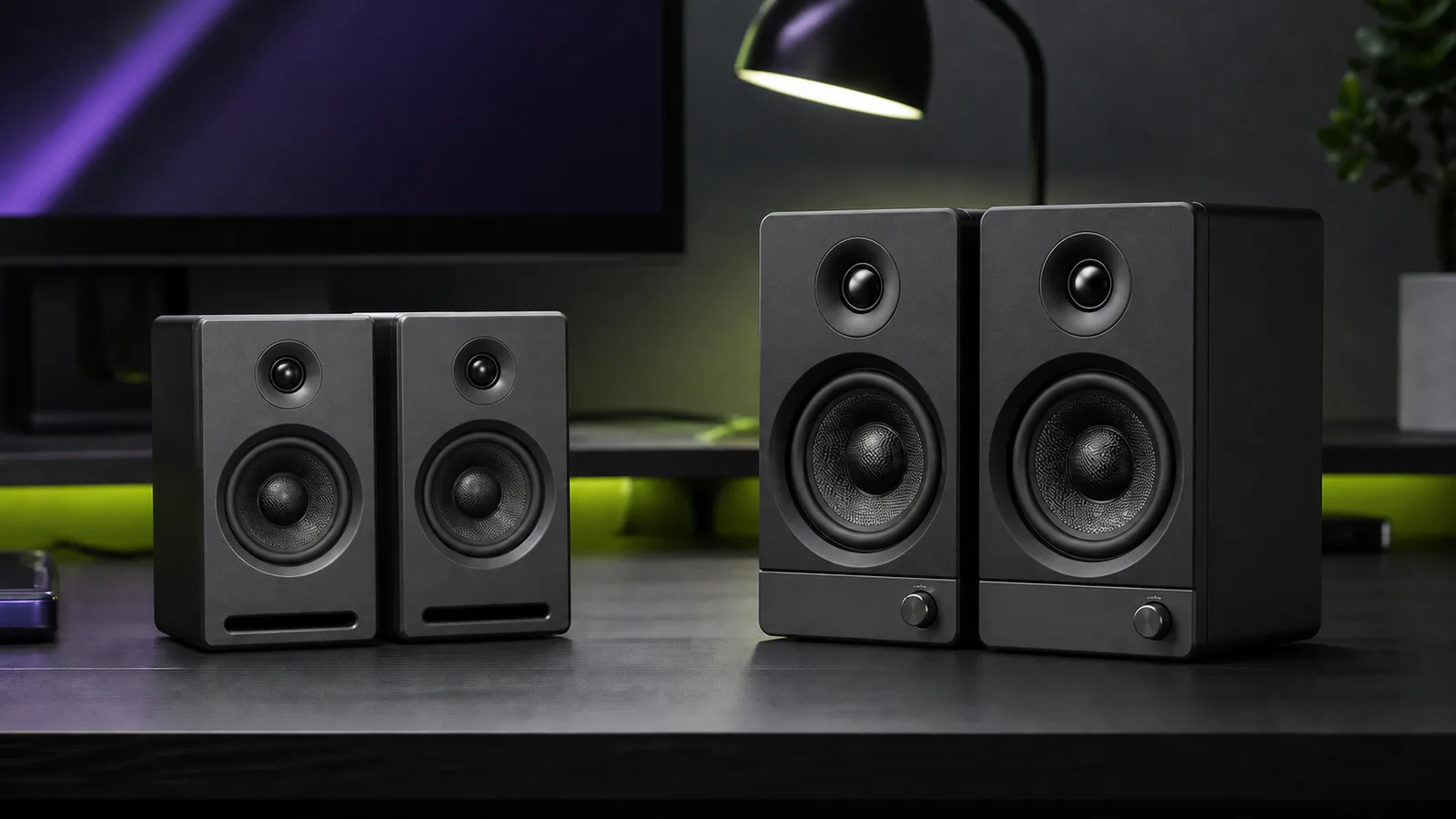
| Cabinet layout | Front-ported | Rear-ported | A2+ is less awkward close to a wall, though either still benefits from sensible placement |
| Controls | Volume/power control on the rear | Volume and input control on the front | ORA is easier to adjust by hand |
| Size per speaker | 6 × 4 × 5.25 inches | 6.9 × 3.9 × 5.6 inches | Width is almost identical; ORA is taller and slightly deeper |
| Optical or HDMI | Neither | Neither | Look elsewhere if a TV is a major source |
The short answer: convenience or a cleaner upgrade path
These are both compact powered stereo systems. Neither needs a separate amplifier. In each pair, one cabinet contains the electronics and drives the other speaker through an included cable.
The A2+ Next Gen is the more forgiving desktop product. Its cabinet is shorter, its bass ports face forward, it accepts both 3.5mm and RCA analog signals, and its Bluetooth implementation lists aptX-HD. It is the sensible choice when the brief is simply “give this small desk proper stereo speakers without turning it into an audio project.”
If the A2+ is already your likely choice, our dedicated Audioengine A2+ Next Gen review covers the current USB-C generation, setup checklist, Bluetooth-latency limit, and reasons to skip it without repeating this pairwise comparison.
The ORA is the more deliberate nearfield system. Kanto gives it separate amplification for the tweeters and woofers, more published continuous power, a 24-bit/96kHz USB-C input, front controls, threaded mounting points, and an automatic crossover when a subwoofer is connected. Those features matter if you expect the system to grow.
Do not pay for ORA because a larger number on the power line looks impressive. Pay for it if the front controls, USB implementation, or subwoofer crossover solve a problem you actually have.
USB audio: both are easy, ORA publishes the stronger format
Both speakers can take digital audio directly from a computer over USB-C. That avoids relying on a noisy or inconvenient headphone output on a desktop, monitor, or dock.
Audioengine specifies the A2+ Next Gen USB input as 24-bit padded at 48kHz. The word “padded” matters. It is not the same claim as a native 24-bit converter operating across multiple high sample rates, and buyers should not turn it into a vague “hi-res” performance guarantee. It is still a straightforward plug-and-play computer connection.
Kanto specifies ORA's USB-C input at up to 24-bit/96kHz. That is the more capable published USB format. It can be relevant for a workstation where the speakers are the main output device and the source library or production software uses higher sample rates.
For ordinary streaming, calls, games, and compressed music, the format difference should not decide the purchase on its own. Speaker placement, listening distance, room reflections, and the recording will usually matter more. Choose ORA for 24/96 because your workflow needs it, not because a larger sample-rate number automatically means audible improvement.
Neither speaker includes optical input or HDMI ARC. If you need a pair to switch frequently between a computer and a TV, that omission is more important than the USB specification.
Bluetooth: A2+ has the codec advantage
The A2+ Next Gen uses Bluetooth 5.3 and Audioengine lists aptX-HD, aptX, AAC, and SBC. Compatible Android phones and other aptX-HD sources get a documented higher-bit-depth codec path. Apple devices will use AAC rather than aptX-HD.
Kanto lists Bluetooth 5.0 for ORA but does not advertise aptX on the current product page or specification table. Buy it expecting standard Bluetooth convenience, not a particular premium codec.
This does not make the A2+ a measured wireless sound winner. Codec support is one part of the chain. The source device, implementation, loudspeaker tuning, room, and listening level still matter. The honest conclusion is narrower: A2+ offers the better documented Bluetooth feature set.
USB remains the more predictable desk connection for either pair. Bluetooth is useful for a phone, tablet, or guest device, but it should not be the only reason to spend this much on compact powered speakers.
Amplification and output: useful numbers, limited conclusions
Audioengine rates the A2+ Next Gen at 15W RMS per channel into 4 ohms, with a Class AB amplifier in the powered left cabinet. Kanto rates ORA at 50W total RMS, split across separate Class D amplifier channels for its tweeters and woofers.
Those ratings are not directly interchangeable proof of loudness. Driver sensitivity, DSP, limiting, crossover design, distortion, listening distance, and the test method all affect real output. Peak-watt figures are even less useful for choosing between them.
What the specifications do support is a buyer-fit distinction:
- A2+ Next Gen: designed as a compact home music system for desktops and smaller rooms.
- Kanto ORA: built around higher published continuous output and a bi-amplified, DSP-managed architecture for nearfield use.
If you need to fill a large open room, skip both rather than asking tiny woofers to behave like larger bookshelf speakers. Our best computer speakers guide explains when a bigger cabinet is the better answer.
Bass and subwoofers: ORA handles the handoff better
Both systems let you add a powered subwoofer, but they do not manage it in the same way.
The A2+ has a variable RCA line output. Its level follows the speaker volume, which makes it practical for a subwoofer. The main speakers continue playing their normal range, though, so the subwoofer's controls and placement do most of the integration work.
ORA has a dedicated subwoofer output and an automatic 100Hz crossover. When a sub cable is connected, Kanto says frequencies above 100Hz go to the speakers while frequencies below 100Hz are sent to the sub output. That reduces the low-frequency workload on ORA's 3-inch woofers and creates a clearer setup path.
This is ORA's strongest functional advantage. A buyer planning to add a sub later is not just paying for an extra socket. They are paying for the system to divide the work automatically.
Neither design makes a subwoofer mandatory. For background music, videos, games at moderate volume, and normal home-office listening, it is sensible to start with the speaker pair alone. Add a sub only when you know the missing bass is worth the floor space, cable, and neighbour implications.
Desk placement: measure height and depth, not just width
The cabinets are close in width. Audioengine lists each A2+ speaker at 4 inches wide; Kanto lists ORA at 3.9 inches. The meaningful physical differences are elsewhere.
The A2+ is 6 inches tall and 5.25 inches deep. Its tuned ports face forward. ORA is 6.9 inches tall and 5.6 inches deep, with rear ports. That extra height can interfere with the lower edge of a monitor, and rear ports deserve breathing room from a wall.
Front ports do not make the A2+ immune to placement problems. A corner, hollow desk, or speaker pushed directly against a wall can still produce uneven bass. It is simply the less awkward of these two when the desk is shallow.
Before ordering either pair:
- Measure the clear width beside each monitor stand or arm.
- Check whether the tweeters can point toward ear height rather than your chest.
- Leave room behind ORA instead of pressing it against a wall.
- Budget for small stands or isolation pads if the desktop vibrates.
- Confirm that the cable between left and right speakers can cross the desk cleanly.
If a monitor stand is consuming the space where speakers should sit, our monitor-arm guide and desk setup essentials are the more useful first upgrade.
Controls and daily use
The A2+ puts its power and volume control on the rear of the powered speaker. That keeps the front clean, but it is less convenient when the speakers sit below a shelf or close to a wall. Audioengine also keeps its inputs active, so connected sources do not require a front-panel input selector.
ORA puts its multifunction control on the front. Kanto uses it for power, volume, input selection, and Bluetooth pairing. A front control is easier when you change sources or volume at the speakers rather than using the computer's software volume.
There is no universal winner here:
- choose A2+ if you like a clean front and mostly control volume from one computer;
- choose ORA if you swap inputs or want a physical control within sight and reach.
Neither is a wireless multiroom speaker, smart speaker, soundbar, or conference speakerphone. They are compact stereo speakers. That narrower job is why they make sense on a desk.
Who should buy the Audioengine A2+ Next Gen?
Buy the A2+ Next Gen if:
- your desk is shallow or the speakers must sit reasonably close to a wall;
- you want both 3.5mm and RCA analog inputs;
- aptX-HD matters for a compatible Bluetooth source;
- you want a straightforward USB-C computer connection;
- you are unlikely to build the system around a subwoofer;
- ORA's extra features do not justify its usual premium for your setup.
The main trade-off is the simpler upgrade path. You can add a subwoofer, but the A2+ does not publish the automatic 100Hz high-pass and low-pass behavior that makes ORA's integration unusually tidy.
Audioengine A2+ Next Gen
Why it works
- Front ports suit shallow desks
- USB-C plus two analog input types
- aptX-HD, AAC, and SBC support
Main trade-off
- Rear-mounted volume control
- Simpler subwoofer integration than ORA
Who should buy the Kanto ORA?
Buy ORA if:
- you want the higher published continuous-power rating;
- a 24-bit/96kHz USB input fits your production or playback workflow;
- you plan to add a powered subwoofer;
- front-mounted volume and input controls are useful;
- threaded mounting points or Kanto's stand options suit the desk;
- a slightly taller, rear-ported cabinet is easy to place correctly.
The main compromise is value. ORA's extra hardware is useful, but it is easy to pay for specifications that never change your daily listening. If the speakers will remain a basic USB pair at moderate volume, A2+ is the more economical decision.
Kanto's exact black ORA Amazon listing was identifiable during research, but Amazon showed it as unavailable. We are linking the manufacturer rather than sending readers to an unavailable product page or a loose search result.
Kanto ORA
Why it works
- 24-bit/96kHz USB-C input
- Automatic 100Hz subwoofer crossover
- Front control and threaded mounts
Main trade-off
- Rear ports need placement room
- Costs more than many desk users need to spend
Who should skip both?
Skip both if you need optical input or HDMI ARC. A TV-first setup is better served by powered speakers with optical, an HDMI-equipped speaker system, or a soundbar.
Skip both if deep bass is required but a subwoofer is not possible. A larger powered bookshelf speaker with a bigger woofer is the more honest solution.
Skip both if the desk has no space to place a real stereo pair. One speaker hidden behind a monitor and the other beside a wall defeats much of the reason to buy them. Good headphones or a carefully chosen single speaker can be the better compromise.
Skip both for professional mix decisions based only on manufacturer language. ORA is marketed toward creators and the A2+ borrows from studio-monitor design, but neither claim replaces independent measurements, room correction, or familiarity with a known reference system.
Price and value
Do not choose from a fixed price quoted in an article. Speaker pricing changes by finish, seller, and promotion, and ORA availability can vary.
Use the price gap as a feature test:
- If A2+ is meaningfully cheaper, it is the sensible choice unless you need ORA's USB format or subwoofer crossover.
- If the gap is small, ORA's front controls and upgrade path become easier to justify.
- If adding a sub is certain, include the subwoofer and stands in the total system cost rather than comparing speaker-pair prices alone.
- If both look expensive, do not ignore a cheaper compact speaker simply because it publishes fewer audiophile terms.
For most home offices, we would spend the difference on placement, a monitor arm, or room comfort before paying for unused audio capability.
Alternatives
Creative Pebble Pro or Pebble X: the budget route when the goal is simply clearer desktop audio in very little space. They are not a direct performance substitute, but they solve the basic computer-speaker problem for much less. The dedicated comparison covers desk size, fixed-cable length, and the separate-adapter requirement.
Edifier MR4: worth considering when a larger cabinet fits and wired monitor-style operation is acceptable. Our Edifier MR4 vs R1280DBs comparison explains when balanced inputs matter more than Bluetooth, optical input, and a remote.
Kanto ORA4: the larger Kanto step when ORA's physical limits are the problem. It needs more space and money, so it is not an automatic upgrade for a normal desk.
Portable Bluetooth speaker: useful when one device must move between rooms, but it gives up the fixed stereo image and direct USB workflow of a proper pair. See our Bluetooth speaker guide if portability matters more than desk stereo.
Our complete home audio setup maps where desk speakers fit beside headphones, earbuds, and microphones.
FAQ
Does the Audioengine A2+ Next Gen support USB-C?
Yes. Audioengine lists a USB Type-C input and includes USB computer audio in the current A2+ Next Gen specification. The published USB format is 24-bit padded at 48kHz.
Does Kanto ORA support 24-bit/96kHz audio?
Yes. Kanto lists the ORA USB-C input at up to 24-bit/96kHz. That is a connection-format specification, not proof that every listener will hear a benefit over 48kHz material.
Which speaker is easier to place close to a wall?
The A2+ is the easier choice because its bass ports face forward and the cabinet is slightly shallower. ORA uses rear ports and benefits from clearance behind it. Either speaker can still sound uneven when crowded into a corner.
Which is better with a subwoofer?
ORA has the cleaner published integration. Connecting a sub activates a 100Hz crossover that routes higher frequencies to the speakers and lower frequencies to the sub output. A2+ provides a variable line output, but its main speakers continue with their normal range.
Can either connect directly to a turntable?
Only if the turntable has a built-in phono preamp or an external phono preamp sits between the turntable and speakers. Both accept line-level RCA; neither replaces a phono stage for a bare cartridge signal.
Which is better for gaming?
Either can work well as a compact wired stereo pair. Use USB or analog rather than Bluetooth when predictable latency matters. We would not declare an imaging, bass, or positional-audio winner without matched testing.
Do the A2+ or ORA have optical input or HDMI ARC?
No. The current specification lists do not include optical or HDMI. Choose a different speaker system if a television is a core source.
Final recommendation
Buy the Audioengine A2+ Next Gen for the simpler small-desk job. It has the more flexible analog inputs, the better documented Bluetooth codecs, front ports, and a current exact Amazon product page we could validate.
Buy the Kanto ORA when you will use what costs extra: 24-bit/96kHz USB, front controls, higher published continuous output, or the automatic subwoofer crossover. It is the better system to build around, but not automatically the better value.
Sources
- Audioengine A2+ Next Gen technical specifications for amplification, drivers, inputs, outputs, Bluetooth, USB, cabinet design, dimensions, and weight: https://audioengine.com/product-tech-specs/a2-wireless-computer-speakers/
- Audioengine A2+ Next Gen product page for current model identity and connection overview: https://audioengine.com/shop/wirelessspeakers/a2-wireless-computer-speakers/
- Kanto ORA product page for current specifications, controls, inputs, outputs, dimensions, and automatic crossover behavior: https://www.kantoaudio.com/powered-speakers/ora/
- Kanto ORA manual for input operation and subwoofer setup: https://kanto.pxm.pattern.com/share/$2FFi4IEy5
- Kanto ORA technical overview for USB and crossover implementation: https://blog.kantoaudio.com/getting-to-know-ora-features-technology/
As an Amazon Associate I earn from qualifying purchases.