Edifier MR4.5 vs MR5: Which Fits Your Desk?
Choose the compact MR4.5 for a normal creator desk, or the larger three-way MR5 when its cabinet size and extra output headroom make sense.
Research-based comparison
How we evaluateQuick picks
The short answer, with the trade-off

Best for a larger three-way system
Edifier MR5
Trade-off: Powered cabinet is 51mm deeper than MR4.5
On this page
- Quick answer
- Edifier MR4.5 vs MR5 comparison
- Who should buy the Edifier MR4.5?
- Who should buy the Edifier MR5?
- The real upgrade is 3-way hardware
- Desk depth is the deciding measurement
- Connectivity is effectively a draw
- Room controls help, but they do not measure the room
- Price and value
- Alternatives
- Common mistakes
- Frequently asked questions
- Final recommendation
- Sources and methodology
Buy the Edifier MR4.5 for a normal creator desk. Buy the MR5 only when you have room for much deeper, heavier cabinets and specifically want its three-way driver system and higher published output.
The two models otherwise share most of the useful features: balanced XLR and TRS inputs, RCA, front AUX and headphone sockets, Bluetooth 6.0 with LDAC and multipoint, app-based EQ, and placement controls. The MR5 is not the connectivity upgrade. It is the larger acoustic system.
SolderMag has not completed matched listening, acoustic measurements or long-term testing of either pair. This comparison is based on current Edifier specifications, support material, exact US product identities and the physical consequences buyers can check before ordering.
Quick answer
Choose MR4.5 if the speakers will sit beside a monitor on a normal desk. Its 140mm-wide cabinets are easier to place, the pair weighs 6.63kg, and the 2-way system still provides the same main wired and wireless connection types as MR5. It is the practical choice when desk depth is limited or you do not need a separate midrange driver.
Choose MR5 for a deeper desk or stands when the three-way design and extra published output headroom are deliberate priorities. It uses a 5-inch woofer, dedicated 3.75-inch midrange driver and 1-inch tweeter in each cabinet. The trade-off is a 10.38kg pair with a powered cabinet 280mm deep before cables.
Skip both if you need direct USB audio, optical input, HDMI ARC, a remote or a dedicated subwoofer output. Those connections are not listed for either model.
Edifier MR4.5 vs MR5 comparison
| Decision | Edifier MR4.5 | Edifier MR5 | Buying consequence |
|---|---|---|---|
| Speaker design | 2-way, bi-amplified | 3-way, tri-amplified | MR5 gives bass, midrange and treble separate drivers and amplifier channels |
| Drivers per speaker | 4.5-inch mid-bass, 1-inch tweeter | 5-inch woofer, 3.75-inch midrange, 1-inch tweeter | The extra MR5 driver is the main hardware difference |
| Published total output | 80W RMS | 110W RMS | MR5 has more paper headroom; this is not a measured loudness or sound-quality result |
| Published response | 50Hz–40kHz | 46Hz–40kHz | Different lower figures do not prove usable bass extension without a shared tolerance and test |
| Balanced inputs | XLR and 6.35mm TRS | XLR and 6.35mm TRS | Either fits a conventional audio interface or mixer |
| Other inputs | RCA, front AUX, Bluetooth 6.0 | RCA, front AUX, Bluetooth 6.0 | Connectivity is not a reason by itself to move up to MR5 |
| Wireless codecs | LDAC and SBC | LDAC and SBC | Both support the same published high-resolution Bluetooth path |
| App and room controls | ConneX EQ, low cut-off, acoustic-space and desktop controls | ConneX EQ, low cut-off, acoustic-space and desktop controls | Both can be adjusted for placement; neither is automatic room correction |
| Powered cabinet | 140 × 244 × 229mm | 159 × 264 × 280mm | MR5 is wider, taller and 51mm deeper before cable clearance |
| Pair weight | 6.63kg | 10.38kg | MR5 needs a sturdier desk or stands |
| Headphone output | Front 3.5mm | Front 3.5mm | Either can hand the analog path to headphones |
| USB / optical / sub out | None listed | None listed | Neither is a one-cable computer speaker or simple 2.1 system |
Who should buy the Edifier MR4.5?
Buy MR4.5 if:
- the speakers must fit beside a monitor on a normal-depth desk;
- you listen mainly at close range;
- balanced XLR or TRS connects to an interface or mixer;
- Bluetooth is useful for a phone or second computer;
- app-based placement controls solve a real desk or wall problem;
- moving a 6.63kg pair is more realistic than handling MR5's 10.38kg;
- the saving can go toward stands, isolation, an interface or basic room treatment.
MR4.5 is not the budget model in this family. It already provides the input set and adjustment tools most mixed work-and-listening desks need. The reason to choose it over MR5 is not that its specifications are close enough. It is that its smaller system is easier to place correctly.
Edifier MR4.5
Choose it when you want the modern MR connection and room-control package without committing to a much larger three-way pair.
Why it works
- Smaller and 3.75kg lighter as a pair
- Balanced XLR and TRS plus Bluetooth with LDAC
- App-based placement and EQ controls
Main trade-off
- No dedicated midrange driver
- Current specifications list no USB, optical or subwoofer output
- Published specifications do not establish sound quality
Who should buy the Edifier MR5?
Buy MR5 if:
- a large desk, console or stands can accommodate 280mm-deep powered cabinets plus cables;
- the three-way design is a deliberate purchase rather than a bigger-number reflex;
- higher published output is useful for the room and listening position;
- a dedicated midrange driver is worth the extra space, weight and cost to you;
- the speakers can be positioned symmetrically instead of squeezed around a display.
The MR5 is the more ambitious speaker. Its dedicated midrange drivers cover the band between the 5-inch woofers and 1-inch tweeters, with Edifier listing crossover points at 155Hz and 2,600Hz. That architecture can reduce the bandwidth each driver must handle. It does not prove smoother response, lower distortion or better integration without comparable measurements.
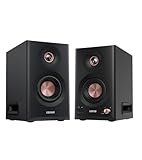
Edifier MR5
Choose it when the three-way system and extra published output fit a larger, properly planned setup.
Why it works
- Three-way system with dedicated midrange drivers
- Higher published output
- Balanced XLR and TRS plus Bluetooth with LDAC
Main trade-off
- Powered cabinet is 51mm deeper than MR4.5
- Pair is 3.75kg heavier
- Current specifications list no USB, optical or subwoofer output
The real upgrade is 3-way hardware
MR4.5 uses a 4.5-inch mid-bass driver and 1-inch tweeter in each cabinet. Its two amplifier paths divide the signal between those drivers.
MR5 adds a 3.75-inch midrange driver between a 5-inch woofer and 1-inch tweeter, with three amplifier paths per speaker. This is the reason to consider it. A dedicated midrange can let the woofer concentrate on lower frequencies while the tweeter avoids being crossed unusually low.
That is an engineering distinction, not a listening verdict. Crossover design, driver behaviour, cabinet resonances, directivity, distortion and placement determine whether the extra complexity pays off. If you cannot explain why you want a three-way nearfield system, buy MR4.5 and spend more effort on placement.
Desk depth is the deciding measurement
The powered MR4.5 cabinet is 229mm deep. The powered MR5 cabinet is 280mm deep. The 51mm difference understates the real setup cost because both need space for rear cables and access to their controls.
On a 600mm-deep desk, larger cabinets can force the front baffle too close to the listener or leave the rear panel against a wall. Moving the desk forward or using stands may solve that, but those are room decisions, not free upgrades.
MR5 is also 19mm wider and 20mm taller per cabinet. That sounds minor until a wide monitor, arm, microphone, desktop PC and interface already occupy the surface. The pair weighs 10.38kg, 3.75kg more than MR4.5.
Before buying:
- Measure clear width and depth on both sides of the display.
- Add room for rear cables and knob access.
- Check that both speakers can sit at equal distances from the listening position.
- Put tweeters near ear height or use stable stands that angle them correctly.
- Avoid putting one speaker in a corner while the other sits in open space.
- Confirm the desk, shelf or stands can support the full pair safely.
A monitor arm can free usable space, but it cannot turn a shallow desk into a good place for a deep speaker cabinet.
Connectivity is effectively a draw
Both models have balanced XLR and 6.35mm TRS inputs for an interface or mixer, plus RCA, front AUX and a front headphone output. Both list Bluetooth 6.0 with LDAC, SBC and multipoint connection.
Bluetooth is the convenience path. Codec support does not establish end-to-end latency, and we have not measured either model for games, instruments or lip-synced editing. Use a wired input when timing matters; choose XLR or TRS by source and cable route rather than assuming one balanced connector sounds better.
Neither current specification lists USB audio, optical input, HDMI ARC or a remote. A USB-only laptop needs an interface, DAC, dock or adapter with a suitable analog output, and a television-first setup deserves a different speaker.
Room controls help, but they do not measure the room
The ConneX app provides low cut-off, acoustic-space, desktop and custom EQ controls for both models. They are adjustment tools, not automatic room correction: neither system lists a measurement microphone or a process that analyses the listening position. Start with physical placement, then change one setting for a specific problem.
The same caution applies to the published response ranges. Edifier lists MR4.5 at 50Hz–40kHz and MR5 at 46Hz–40kHz, but does not give one shared tolerance in those headline figures. A four-hertz difference at the bottom of a manufacturer range is not evidence that one pair produces meaningfully deeper clean bass in your room.
Neither model lists a dedicated subwoofer output. A sub may be inserted upstream through suitable equipment, but this is not the simple consumer 2.1 path offered by speakers with a managed sub output.
Price and value
Compare the exact products and sellers when you buy. Do not anchor the decision to a fixed price from an old review.
MR4.5 is the value choice when it already meets the required input, control and output needs. Correct placement, sturdy stands and an appropriate source can matter more than buying a larger cabinet that does not fit.
MR5 is worth paying for when the three-way system, greater published output and larger physical scale belong in one coherent setup. It is poor value when it sits too close, blocks a screen, crowds the desk or forces asymmetrical placement.
Our rule is simple: buy MR4.5 by default; move to MR5 for a planned acoustic reason. “It is the higher model” is not a plan.
Alternatives
Edifier MR4: choose the simpler entry model if Bluetooth, XLR and app controls are unnecessary. It keeps balanced TRS, RCA and AUX in a smaller cabinet. Our MR4.5 vs MR4 comparison explains whether the modern feature set is worth paying for.
Edifier MR3: the compact current option for a tight desk. It adds Bluetooth and app controls in a smaller 3.5-inch two-way system. Read the MR3 vs MR4 comparison for the space-first decision.
Audioengine A2+ Next Gen: a much smaller premium pair with direct USB-C audio and Bluetooth. It is the better path when a compact digital computer connection matters more than balanced studio inputs.
Kanto ORA: another compact USB-C option with a managed subwoofer path. Our Audioengine A2+ vs Kanto ORA comparison covers those smaller systems.
Edifier R1280DBs: choose this mixed-use route when optical, coaxial, a remote and a dedicated subwoofer output matter more than balanced XLR or TRS. The MR4 vs R1280DBs comparison explains the connection trade-off.
Our best computer speakers guide compares the wider category, from tiny USB speakers to larger powered monitors.
Common mistakes
Assuming MR5 is simply MR4.5 with more power. Its three-way driver system and much larger cabinets change the placement decision.
Buying from front-view dimensions. Depth and rear cable clearance are the constraints most likely to break a desktop setup.
Treating 110W versus 80W as a sound-quality score. Amplifier output does not establish response accuracy, distortion, directivity or clean output under one shared test.
Expecting USB-C audio. Neither current specification lists it; plan an analog source or Bluetooth connection.
Using Bluetooth for timing-sensitive work. Use XLR, TRS, RCA or AUX when latency matters.
Expecting automatic room correction. The app provides adjustment tools, not microphone-guided calibration.
Frequently asked questions
Is Edifier MR5 better than MR4.5?
MR5 is the more ambitious system: it has a three-way driver layout, larger cabinets and higher published output. MR4.5 is easier to place and offers essentially the same input and app features. Without matched measurements or listening, this comparison does not claim that MR5 sounds better.
Is MR5 worth the upgrade over MR4.5?
It is worth considering when the larger cabinets fit and you deliberately want the three-way system and extra published output headroom. MR4.5 is the better default when both pairs would serve the same nearfield desk job.
How much bigger is MR5 than MR4.5?
The powered MR5 cabinet is 159 × 264 × 280mm, compared with 140 × 244 × 229mm for MR4.5. MR5 is 51mm deeper before allowing room for cables. The MR5 pair weighs 10.38kg versus 6.63kg for MR4.5.
Do MR4.5 and MR5 have the same inputs?
Their main connection lists match: balanced XLR, balanced TRS, RCA, front AUX, Bluetooth 6.0 and a front headphone output. Neither current specification lists USB audio, optical, HDMI ARC or a dedicated subwoofer output.
Can MR4.5 or MR5 connect directly over USB?
No direct USB audio input is listed. A USB-only computer needs a compatible interface, DAC, dock or adapter that provides an appropriate analog output, or it can use Bluetooth for non-critical listening.
Can I add a subwoofer to MR4.5 or MR5?
Neither model lists a dedicated subwoofer output. Integration may be possible upstream through an interface, monitor controller or subwoofer with suitable pass-through connections, but it is not a simple plug-in upgrade managed by the speakers.
Final recommendation
Buy the Edifier MR4.5 for most creator desks. It supplies the useful modern connections, Bluetooth and placement controls in a cabinet that is easier to position and a pair that is easier to support.
Buy the Edifier MR5 when a larger desk or stands can accommodate it and the three-way system is the reason for spending more. Its extra driver and output are meaningful hardware differences, but they do not rescue poor placement.
Measure the desk first. If both pairs would serve the same close desktop setup and use the same inputs, MR4.5 is the sensible choice.
Sources and methodology
- Edifier official MR4.5 product page and specifications for the driver layout, output, response, inputs, Bluetooth, app features, dimensions, weight and box contents.
- Edifier official MR5 product page and specifications for the three-way layout, output, response, crossover points, inputs, Bluetooth, room controls, dimensions and weight.
- Edifier official MR5 user manual for controls, wired connections and Bluetooth behaviour.
- Edifier official speaker comparison tool for current family positioning and cross-model specifications.
- Amazon Creators API exact-product validation for Edifier MR4.5 black
B0H2VQ581Yand Edifier MR5B0F5B73RGTin the US marketplace with SolderMag's configuredsoldermag-20Associate tag.
This page compares documented hardware, inputs, controls, size and buyer scenarios. It does not make matched sound, bass-extension, distortion, maximum-output, Bluetooth-latency, build-quality or long-term reliability claims. The hero is an original model-neutral illustration, not a photograph of either exact retail product.
As an Amazon Associate I earn from qualifying purchases.