Anker Prime 100W vs UGREEN Nexode 100W: Which Charger Should You Buy?
Anker Prime 100W vs UGREEN Nexode 100W compared on ports, size, charging behavior, thermals, value, and who should buy each GaN charger.
Editorial evidence review
Recommendations are checked against product documentation, availability, comparative evidence, and clearly disclosed hands-on work where it exists.
Quick picks
The short answer, with the trade-off
Best overall
Anker Prime 100W GaN Charger (3 Ports)
Runs cooler under sustained load
Trade-off: Only 3 ports vs UGREEN's 4

Best value
UGREEN Nexode 100W GaN Charger (4 Ports)
Trade-off: Runs warmer under full load
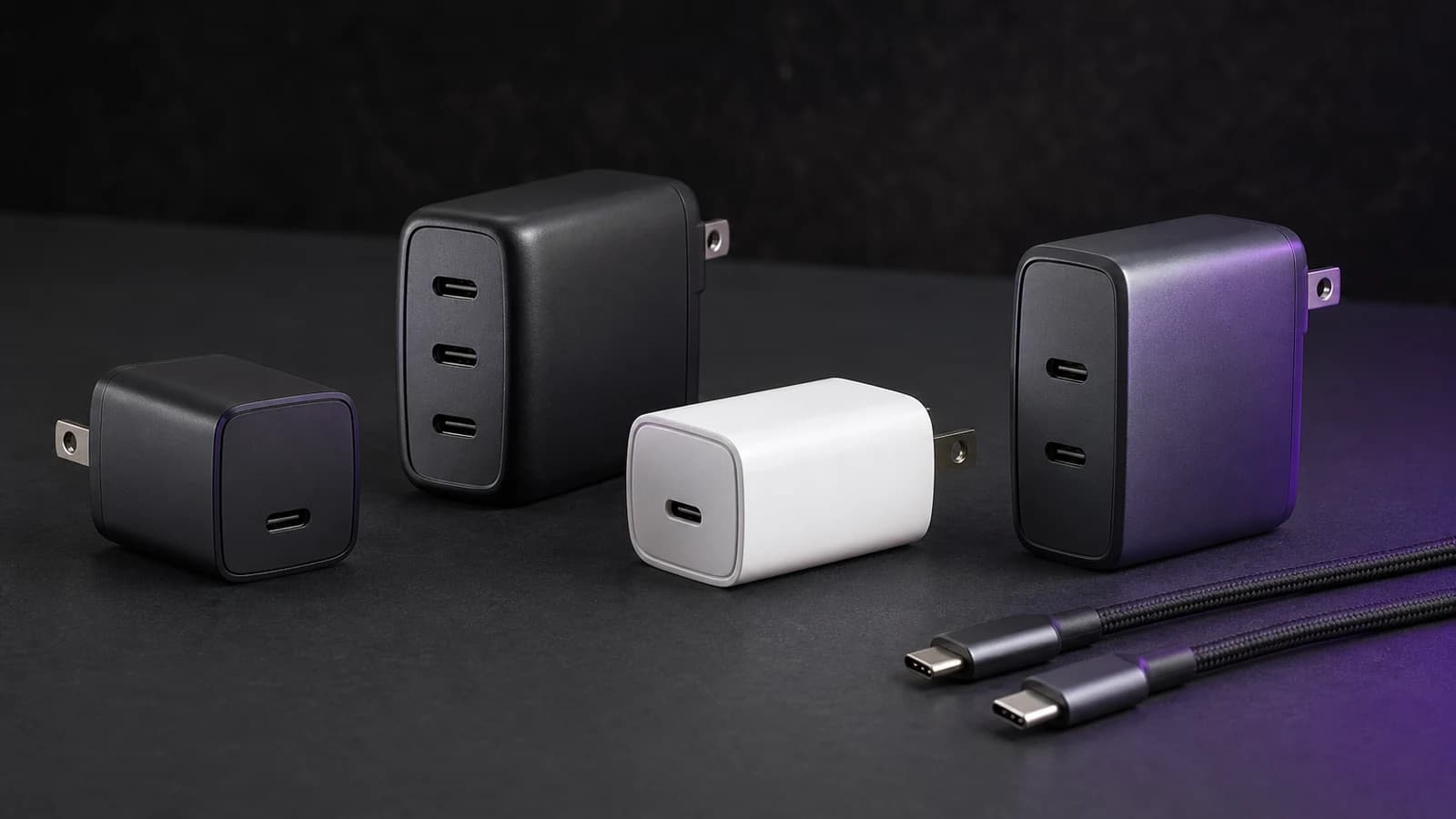
The Anker Prime 100W and the UGREEN Nexode 100W are the two chargers that keep showing up in every 100W GaN charger shortlist. Both can replace a laptop brick, both can charge multiple devices at once, and both are from brands with real distribution instead of throwaway marketplace listings.
They are close in total wattage, close enough in price that sales can flip the value call, and similar enough that the wrong choice is not disastrous. The difference is practical: the Anker is the neater travel charger, while the UGREEN is the better desk charger if you regularly fill every port.
Quick answer
Buy the Anker Prime 100W if you want the safer one-bag charger for a laptop, phone, and one extra device. It is smaller, simpler, and easier to recommend for travel.
Buy the UGREEN Nexode 100W if you want the most ports for the money. Its three USB-C ports plus USB-A make more sense on a desk, especially if you charge a laptop, phone, tablet, and earbuds at the same time.
| Buyer need | Better pick | Why |
|---|---|---|
| Travel charger for a laptop bag | Anker Prime 100W | Smaller body, three-port layout, simpler power sharing |
| Four-device desk setup | UGREEN Nexode 100W | 3x USB-C plus 1x USB-A gives more connection flexibility |
| Most polished build | Anker Prime 100W | Better fit-and-finish and stronger brand support history |
| Lowest usual street price | UGREEN Nexode 100W | Commonly discounted below the Anker |
| Easiest recommendation for most people | Anker Prime 100W | Fewer compromises if you do not need four ports |
SolderMag take: Anker for most laptop bags, UGREEN for crowded desks
The Anker Prime 100W is the more refined charger. It runs cooler under sustained load, the build quality feels a notch above, and Anker's customer support has a longer track record. If you want to buy one charger and not think about it again, this is the pick.
The UGREEN Nexode 100W gives you an extra port (four total vs three), often costs less, and delivers comparable single-device charging. It runs slightly warmer and the plastic feels a half-step cheaper, but the functional difference is small. If you charge more devices simultaneously and want to spend less when it is on sale, the UGREEN is the practical choice.
For a travel charger or a laptop-primary setup: Anker. For a desk where you charge four things at once: UGREEN.
Ports and power allocation
Anker Prime 100W: Three ports total: two USB-C and one USB-A. The primary USB-C port delivers 100W solo. With two devices connected, it splits to roughly 65W + 30W. All three ports occupied drops the primary to about 65W, with the remaining ports sharing 35W. Anker publishes a clear power allocation table, which is refreshing.
UGREEN Nexode 100W: Four ports total: three USB-C and one USB-A. The primary USB-C port does 100W alone. Two USB-C ports split to 65W + 30W. With all four ports used, the allocation gets tighter, and USB-A takes a smaller share. UGREEN also publishes its allocation table, though the four-port juggling is more complex.
Winner: UGREEN for port count. Anker for cleaner power allocation with fewer compromises when fully loaded.
Charging speed
Anker Prime 100W: Each USB-C port can deliver up to 100W when used alone, so it has enough output for a MacBook Air, most 13- and 14-inch laptops, iPads, handheld gaming PCs, phones, and headphones. Phone charging on the secondary port hits standard USB-PD speeds. The main advantage is predictable laptop-first charging when two or three devices are connected.
UGREEN Nexode 100W: Comparable laptop charging on the primary USB-C port. Phone and tablet charging on secondary ports is similarly fast. In single-device use, the two chargers are close enough that you should not buy based on speed alone. The gap appears when you load up all four ports, where the UGREEN has to divide the 100W ceiling more aggressively.
Winner: Tie in single-device use. Anker has a slight edge when multiple ports are in use because there is less power splitting to manage.
Size and portability
Anker Prime 100W: Compact for a 100W charger. Foldable prongs, roughly the size of a thick deck of cards. It fits in a laptop bag pocket without much fuss. The matte black finish resists scuffs.
UGREEN Nexode 100W: Slightly larger than the Anker, which makes sense given the extra port. Still smaller than any laptop brick it replaces. Foldable prongs keep it travel-friendly. The size difference is noticeable side by side but irrelevant in a bag.
Winner: Anker, by a small margin. One fewer port means a slightly smaller body.
Thermals
This is where charger quality separates from charger marketing.
Anker Prime 100W: Runs warm under heavy load but stays within comfortable territory. Sustained laptop charging plus phone charging does not make the charger hot to the touch. Anker's GaN implementation and thermal design have improved with each generation, and the Prime reflects that.
UGREEN Nexode 100W: Runs warmer than the Anker under equivalent load. When charging a laptop and two phones simultaneously, the surface gets noticeably warm. It is not dangerous, and thermal protection will throttle before anything goes wrong, but the warmth is real. In hot environments or enclosed spaces, this matters more.
Winner: Anker. Cooler operation under sustained load is a meaningful quality-of-life difference.
Build quality
Anker Prime 100W: Dense, well-built, with tight seams and a satisfying weight. The prongs fold cleanly. The USB ports have firm insertion and no wobble. It feels like a product that went through multiple design iterations.
UGREEN Nexode 100W: Good build quality but slightly less refined. The plastic has a faintly cheaper feel, and the prong mechanism is not quite as smooth. These are minor complaints. The charger works well and nothing feels fragile. But if you put both chargers on a table, most people would guess the Anker costs more.
Winner: Anker. The fit and finish are a step ahead.
Safety and certifications
Anker Prime 100W: Supports USB-PD 3.0, PPS, and includes Anker's ActiveShield 2.0 temperature monitoring (which checks output temperature multiple times per second). UL listed. Anker's warranty and return process are well established.
UGREEN Nexode 100W: Supports USB-PD 3.0, PPS, and QC 4.0+. UL listed. UGREEN has expanded its warranty support in recent years and now offers solid coverage in the US and EU. No complaints on the safety front.
Winner: Tie. Both chargers meet safety standards and carry reputable brand warranties.
Price and value
The UGREEN Nexode 100W is usually the better value when it is discounted. The Anker Prime 100W is usually the better buy when the prices are close.
You get an extra USB-C port with the UGREEN and save money. You get better thermals and build quality with the Anker. Neither is a bad deal.
Compatibility
Anker Prime 100W: Works with USB-PD devices including MacBooks, Windows laptops, iPads, iPhones, Android phones, Steam Deck, and Nintendo Switch. If your device charges from USB-C and needs 100W or less, the Anker is in the right class.
UGREEN Nexode 100W: Same broad USB-C compatibility, plus Quick Charge support for older Android devices that use Qualcomm Quick Charge rather than USB-PD. This is a minor edge, but it matters if your device ecosystem includes older Samsung, Xiaomi, or similar Android hardware.
Winner: UGREEN, by a narrow margin. QC 4.0+ adds compatibility the Anker lacks.
Quick spec comparison
| Anker Prime 100W | UGREEN Nexode 100W | |
|---|---|---|
| Total wattage | 100W | 100W |
| Ports | 2x USB-C, 1x USB-A | 3x USB-C, 1x USB-A |
| Max single port | 100W USB-C | 100W USB-C |
| GaN | Yes (GaN III) | Yes (GaN II) |
| Foldable prongs | Yes | Yes |
| USB-PD | 3.0 + PPS | 3.0 + PPS + QC 4.0+ |
| Weight | ~200g | ~220g |
The verdict
Anker Prime 100W GaN Charger (3 Ports)
Why it works
- Runs cooler under sustained load
- Compact design with foldable prongs
- Clean power allocation across 3 ports
Main trade-off
- Only 3 ports vs UGREEN's 4
- Slightly higher price

UGREEN Nexode 100W GaN Charger (4 Ports)
Why it works
- 4 ports including 3 USB-C
- Lower price than Anker
- QC 4.0+ support for Android
Main trade-off
- Runs warmer under full load
- Slightly bulkier body
- Build quality a half-step behind Anker
Decision checklist
Buy the Anker Prime 100W if you:
- Primarily charge a laptop and one or two other devices
- Want the charger that runs coolest under load
- Travel frequently and value compact size
- Prefer Anker's established warranty and support
- Care about build quality and materials
Buy the UGREEN Nexode 100W if you:
- Charge four devices regularly (laptop, phone, tablet, earbuds)
- Want to save $10 to $15 without a major quality drop
- Need QC 4.0+ for older Android devices
- Value port count over thermal headroom
- Use the charger at a desk rather than in a bag
Consider something else if you:
- Need 200W+ for multiple laptops (see our best 200W multi-port chargers roundup)
- Want a single-port charger for maximum simplicity (the Anker 317 in our 100W GaN charger guide is solid)
- Are unsure what wattage you need (start with our USB-C charger wattage guide)
What we checked
This comparison is based on manufacturer specifications, current retail listings, known USB-C PD behavior, buyer feedback patterns, and our broader charger coverage. We did not run a fresh thermal bench for this June 2026 update, so we avoid lab-style temperature claims.
Official references: Anker's Prime 100W spec page, Anker support power-distribution notes, and UGREEN's Nexode 100W product page.
For the full ranked list of 100W chargers, see our best 100W USB-C GaN chargers in 2026 guide. And make sure you pair any charger with a cable that can handle the power. Our USB-C cable guide covers that.