Best Robot Vacuums (2026): What Actually Matters (and What’s Pure Marketing)
The best robot vacuums of 2026 that navigate well, empty reliably, and don’t turn mopping into a science project. What to buy for your home.
Research-based buying guide
Recommendations are checked against product documentation, availability, comparative evidence, and clearly disclosed hands-on work where it exists.
Quick picks
The short answer, with the trade-off
Best overall
Dreame X60 Ultra
35,000Pa manufacturer suction claim
Trade-off: High premium price
Anti-tangle alternative
Roborock Qrevo CurvX
Trade-off: Cleaning advantage not independently verified

Best for power users
Dreame L50 Ultra
Trade-off: Occasional obstacle issues

Best premium
Roborock Saros 10R
Trade-off: Weaker carpet pet hair pickup
On this page
Robot vacuums are weirdly polarising: half the internet treats them like magic, the other half thinks they’re expensive hockey pucks.
The truth is simple: navigation + the right base station determines whether a robot vacuum feels “worth it” after the honeymoon period.
This guide is how to buy a robot vacuum in 2026 without getting spec‑sheet catfished.
SolderMag Take: the best robot vacuums win on navigation, not suction
Suction numbers are noisy marketing. In real homes, the robots that feel premium are the ones that:
- don’t get lost
- don’t eat cords
- don’t smear wet dirt around
- don’t need babysitting every run
If you can only pay for one upgrade, make it better mapping + obstacle avoidance. If you can pay for two, add a self-emptying dock.
Who should buy a robot vacuum in 2026
Buy a robot vacuum if you:
- have hard floors or low/medium pile rugs
- want “good enough daily” cleaning without thinking about it
- have pets and want to reduce hair tumbleweeds
Skip (or downshift your expectations) if you:
- have lots of tall thresholds / thick shag rugs everywhere
- leave cables, socks, and kid toys on the floor 24/7
- want deep-clean results without ever doing a manual vacuum
The 6 robot vacuum features that actually matter (in order)
1) Navigation & mapping (LiDAR vs camera)
Most modern bots can map a house, but they don’t map equally.
- LiDAR tends to be consistent and fast for mapping and room-to-room routing.
- Camera-based systems can work well, and sometimes do better at recognising objects, but performance varies more by model.
What you’re really buying is: does it finish a run without drama?
2) Obstacle avoidance (the “cord test”)
Obstacle avoidance is the difference between:
- “I run it every night”
- “I only run it when I’m home to watch it”
If your house has cables, pet toys, or the occasional rogue sock, prioritise models known for avoiding small objects.
3) Base station: self-empty is the quality-of-life king
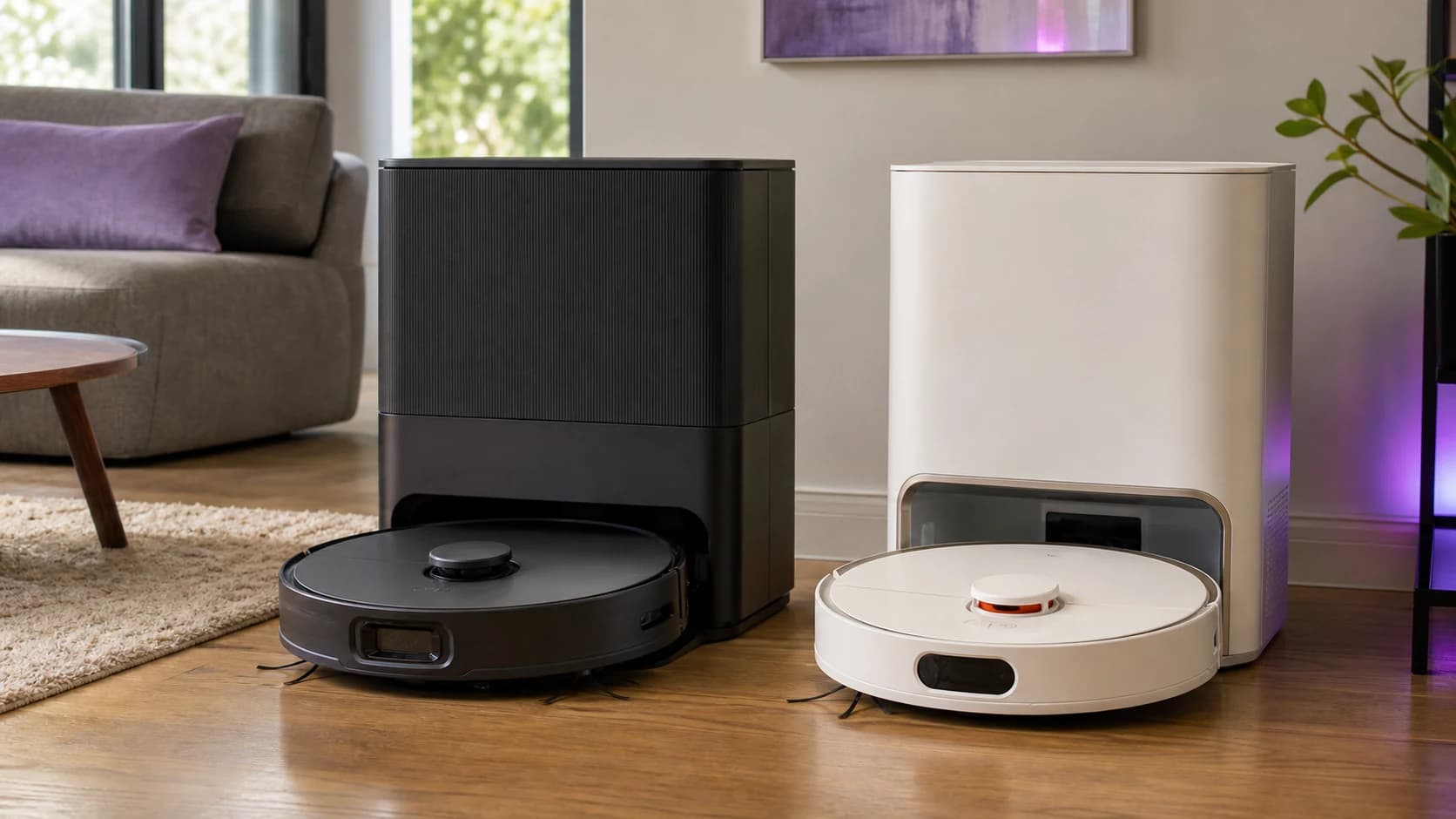
A self-emptying dock is the point where robot vacuums stop being a gadget and start being infrastructure.
Expect:
- less daily maintenance
- better consistency (you don’t skip runs because the bin is full)
If you’re considering a combo vacuum+mop robot, base stations get more complex (see below).
4) Brushes & hair handling (pets, long hair, rugs)
Pet hair and long human hair are the real torture test.
Look for:
- a brush design that resists tangles
- easy access to remove hair when it does happen
- strong edge cleaning if you have baseboards that collect fluff
5) Mopping (good for dust, mixed for “real mess”)
Marketing makes mopping look like a miracle. In practice:
- Robot mops are great at lifting fine dust and improving the “barefoot feel.”
- They are less great at sticky spills unless you pre-treat or run multiple passes.
If you want mopping, look for:
- consistent pad pressure
- a dock that can wash/dry pads (otherwise you’ll hate it)
- a robot that can avoid rugs intelligently during a mop run
6) Apps, maps, and the boring stuff
You want boring reliability:
- stable room mapping
- no random “offline” days
- easy no-go zones
- multi-floor support if you need it
Smart-home integrations are nice, but they’re not the main event.
Robot vacuum traps (how people overspend)
- Chasing suction numbers instead of navigation + brushes.
- Buying a mop combo without a pad-washing dock, then never mopping because it’s gross.
- Getting a “smart” robot while having a floor that’s basically an obstacle course.
- Assuming any robot is a substitute for a real vacuum on deep rugs.
Our top robot vacuum picks by type
These picks map to real buyer intent: navigation reliability, dock quality, pet-hair handling, and whether the mopping system is worth the extra maintenance.
Best overall (most homes)
Prioritise: strong navigation + self-empty dock + good hair handling.
Dreame X60 Ultra
Why it works
- 35,000Pa manufacturer suction claim
- Retracting low-profile navigation
- Self-maintaining mop dock
Main trade-off
- High premium price
Best for pets
Prioritise: anti-tangle brush design + reliable edge cleaning + self-empty dock.
Roborock Qrevo CurvX
Why it works
- 22,000Pa manufacturer suction claim
- DuoDivide anti-tangle system
- AdaptiLift chassis
Main trade-off
- Cleaning advantage not independently verified
Best for hard floors + mopping
Prioritise: pad washing/drying dock + good rug detection/avoidance.

Dreame L50 Ultra
Why it works
- 19,500 Pa suction & detangling brush
- ProLeap climbs 60mm thresholds
- Extending mop & side brush
Main trade-off
- Occasional obstacle issues
Best value
Prioritise: navigation reliability and parts availability over fancy features.

Roborock Saros 10R
Why it works
- Superior obstacle avoidance
- Excellent hard floor & mopping
- Ultra-slim self-maintenance dock
Main trade-off
- Weaker carpet pet hair pickup
Best for small apartments
Prioritise: compact dock, simple mapping, and low noise.
If you want a shortlist to start with, look at current “flagship” and “upper-mid” lines from brands like Roborock, iRobot, Ecovacs, Dreame, and Eufy. then filter based on the checklist below.
Robot vacuum buying checklist
Use this before you buy:
- Do I need self-empty? (If you want low effort, yes.)
- Is my home messy on the floor? (If yes, prioritise obstacle avoidance.)
- Do I actually want mopping, or do I just want floors to feel less dusty?
- Pets / long hair? (Prioritise anti-tangle and maintenance access.)
- Rugs? (Check real-world reviews for your rug type.)
- Can I live with the dock size where it has to go?
Read our research-based Dreame X60 Ultra review for a detailed look at the top pick.
Sources and methodology
- Vacuum Wars (hands-on robot vacuum tests and comparisons): https://vacuumwars.com/
- RTINGS robot vacuum reviews and measurements: https://www.rtings.com/robot-vacuum
- The New York Times Wirecutter (robot vacuum buying advice and testing notes): https://www.nytimes.com/wirecutter/reviews/best-robot-vacuum/
- iRobot support docs (maintenance and troubleshooting reference): https://homesupport.irobot.com/
- Roborock support/docs (feature definitions and maintenance reference): https://support.roborock.com/
If you're upgrading the rest of your home, see our picks for the best air purifiers and best indoor security cameras. Pet owners should also use the focused best robot vacuums for pet hair guide before buying.