Best Projectors (2026): Home Theater and Portable Picks That Don't Suck
The best projectors of 2026 for home cinema, gaming, and outdoor movie nights. Laser, LED, and ultra-short-throw compared.
Editorial evidence review
Recommendations are checked against product documentation, availability, comparative evidence, and clearly disclosed hands-on work where it exists.
Quick picks
The short answer, with the trade-offBest UST
Epson EpiqVision Ultra LS800
4,000 ANSI lumens. watchable with lights on
Trade-off: Premium price
Best for gaming
BenQ TK700STi
Best portable premium
XGIMI Horizon Ultra
Best portable budget
Anker Nebula Mars 3 Air
Trade-off: 400 lumens. dark room required
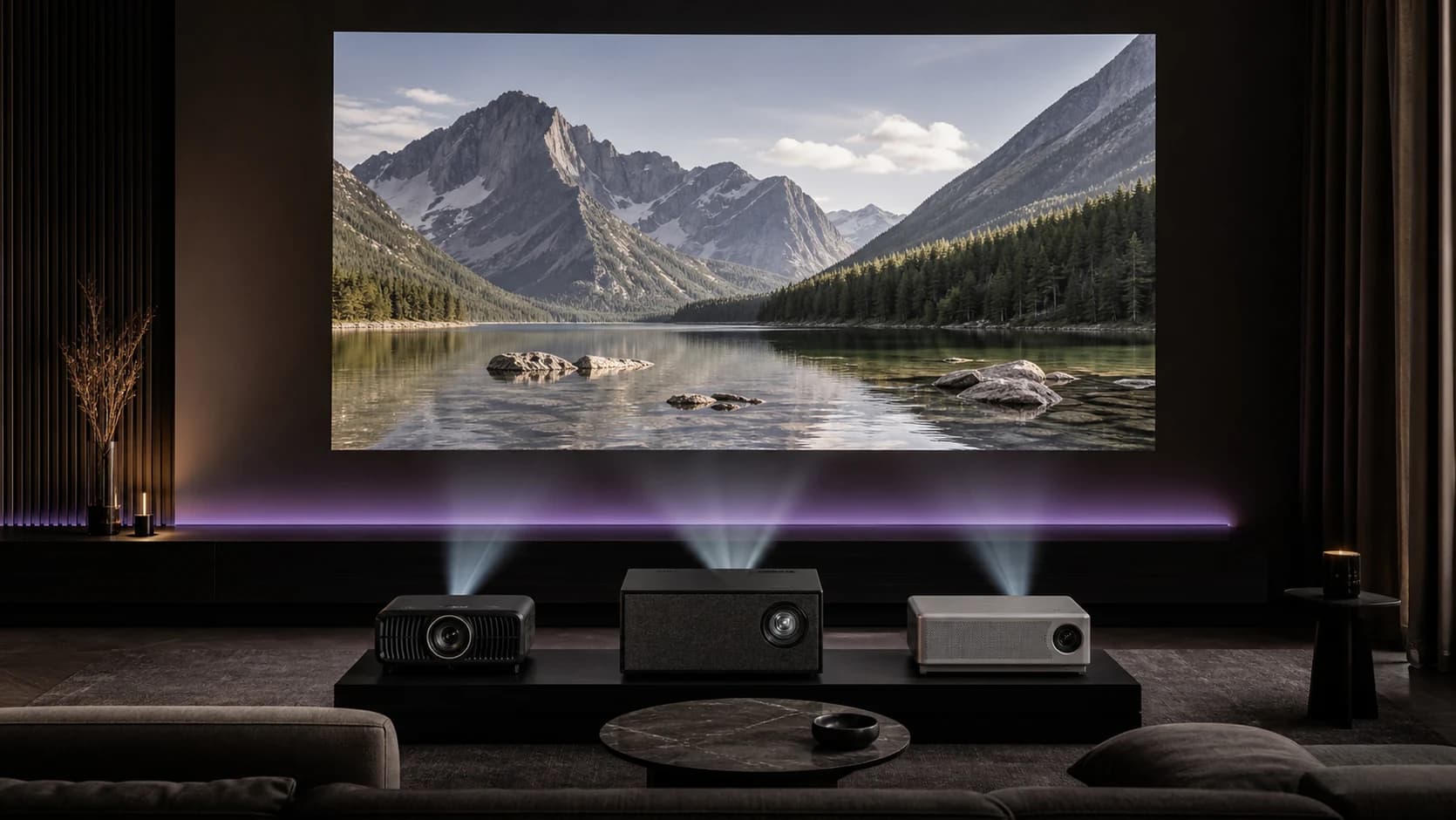
Projectors have a reputation problem. Most people's last experience was a washed-out conference room presentation or a blurry backyard movie that required total darkness and a bedsheet.
Modern projectors are a different species. Laser light sources last 20,000+ hours (no bulb replacements), ultra-short-throw models sit inches from the wall, and even portable units can deliver a watchable 100" image. The technology caught up to the promise.
The problem: the market is flooded with $80 Amazon projectors that claim "native 1080p" and "15,000 lumens." They're lying. Buying a projector in 2026 means knowing which specs are real and which are fiction.
SolderMag Take: buy the light source, not the lumen number
The single most important spec on a projector is the light source type and its real-world brightness. not the inflated lumen number on the box.
Here's the hierarchy:
- Laser. brightest, longest-lasting, instant on/off, most expensive
- LED. good color, long life, lower brightness than laser, great for portable
- Lamp (UHP). cheapest upfront, bulbs degrade and need replacement every 3,000-5,000 hours
In 2026, laser projectors have dropped enough in price that they're the default recommendation for home theater. LED is the right call for portable. Lamp-based projectors are legacy tech unless you're on a strict budget.
If the listing says "lumens" without specifying ANSI lumens, it's probably inflated by 3-5x. Only trust ANSI lumen ratings.
Our top projector picks for 2026
Best ultra-short-throw: Epson EpiqVision Ultra LS800
Ultra-short-throw projectors sit 6-12 inches from the wall and project upward onto the screen. No ceiling mount, no tripping over cables, no shadow when someone walks in front. For a living room setup, UST is the most practical form factor.
The LS800 delivers 4,000 ANSI lumens of laser brightness. enough to watch with the lights on. The 4K PRO-UHD processing handles HDR content well, and the built-in Yamaha-tuned speakers are surprisingly competent (though you'll still want a soundbar or Bluetooth speaker for serious movie nights).
Setup is straightforward: place it on a TV stand against the wall, plug in power and HDMI, and adjust the digital keystone. The 150" maximum image size is overkill for most rooms. 100-120" is the sweet spot.
The price is steep, but remember: this replaces both a TV and a mount. Dollar-per-inch, it competes with 85"+ TVs.
Epson EpiqVision Ultra LS800
Why it works
- 4,000 ANSI lumens. watchable with lights on
- No ceiling mount needed, sits inches from wall
- Built-in Yamaha speakers, Android TV built in
Main trade-off
- Premium price
- Requires ALR screen for best results
Best for gaming: BenQ TK700STi
Input lag kills gaming on most projectors. The TK700STi solves this with a dedicated Game Mode that drops input lag to 16ms at 1080p/60Hz. competitive with many TVs. At 4K/60Hz, you're looking at ~33ms, which is still playable for everything except competitive shooters.
The short-throw lens means you get a 100" image from about 5 feet away, which is practical for apartments and smaller rooms. Brightness at 3,200 ANSI lumens handles ambient light reasonably well, though you'll want curtains for the best contrast.
The built-in Android TV is sluggish (this is true of almost every projector. just plug in a streaming stick). But for gaming via HDMI from a console or PC, the TK700STi delivers a big-screen experience that's hard to match at this price.
BenQ TK700STi 4K Gaming Projector
Why it works
- 16ms input lag in Game Mode
- Short throw. 100" from 5 feet
- 3,200 ANSI lumens for decent ambient light handling
Main trade-off
- Built-in smart OS is sluggish
- Fan noise noticeable in quiet scenes
Best portable premium: XGIMI Horizon Ultra
The Horizon Ultra is the projector for people who want one device that works in the living room, the bedroom, and the backyard. It's portable (11 lbs), runs on AC power (no battery. that's the trade-off for brightness), and delivers genuine 4K with Dolby Vision HDR.
The auto-keystone and auto-focus work shockingly well. Set it on a coffee table pointed roughly at a wall, and it corrects geometry and sharpness in seconds. No manual fiddling. XGIMI's ISA 2.0 system also avoids projecting onto people or obstacles. a small but brilliant feature.
At 2,300 ANSI lumens, it needs a dimmer room than the Epson for peak performance. But in the evening or with curtains drawn, the image quality is excellent. rich color, deep blacks for a DLP, and solid HDR highlights.
XGIMI Horizon Ultra 4K Projector
Why it works
- True 4K with Dolby Vision HDR
- Auto-keystone and auto-focus that actually work
- Versatile. living room to backyard
Main trade-off
- No battery. requires AC power
- Needs dimmer room for best contrast
Best portable budget: Anker Nebula Mars 3 Air
The Mars 3 Air is the projector you throw in a bag for movie night at a friend's place. It has a built-in battery (2.5 hours of playback), a built-in speaker, Netflix pre-licensed (no sideloading needed), and enough brightness at 400 ANSI lumens for a dark room.
Let's be honest about limitations: 400 lumens means any ambient light washes it out. The native 1080p resolution is fine for a 60-80" image but gets soft past 100". And the built-in speaker is adequate, not good.
But for the use case it targets. casual movie nights, camping, backyard screenings after sunset. it delivers a genuinely fun experience for under $500. Pair it with a Bluetooth speaker and a white wall, and you've got a 70" cinema for the price of a mediocre TV.
Anker Nebula Mars 3 Air
Why it works
- Built-in battery for 2.5 hours, Netflix pre-licensed
Main trade-off
- 400 lumens. dark room required
- Soft image past 80 inches
How to choose the right projector in 2026
Work through these in order. most people can eliminate half the market by question two:
- Where will it live? Living room (UST or short-throw), dedicated theater room (standard throw), portable (LED with battery).
- How much ambient light? Bright room = 3,000+ ANSI lumens. Dim room = 1,500+ works. Dark room = even 500 is fine.
- Gaming? Prioritize input lag under 30ms and check refresh rate support.
- Screen size target? 80-120" is the practical range. Bigger isn't better if your room can't support it.
- Do you need a screen? A white wall works for casual use. An ALR (ambient light rejecting) screen dramatically improves UST performance.
- Audio plan? Built-in projector speakers are emergency-grade at best. Budget for a soundbar or external speaker from the start.
- Ceiling mount or furniture? UST sits on furniture. Standard throw usually needs a ceiling mount or shelf. factor in installation cost and cable routing.
Projector buying checklist
- Light source type confirmed (laser, LED, or lamp)
- ANSI lumen rating (not inflated "lumens") matches your room brightness
- Native resolution is real 1080p or 4K (not "supported" or "compatible" resolution)
- Throw distance works for your room (measure wall-to-placement distance)
- Input lag checked if gaming is a priority
- Fan noise level acceptable for quiet viewing (check dB rating)
- Surge protector or UPS for the power input. projectors hate dirty power (see our surge protector picks)
Projector specs that actually matter
Throw ratio: will it fit your room?
Throw ratio determines how far the projector sits from the wall for a given image size. A 1.0 throw ratio means a 100" image from 100" away. Ultra-short-throw ratios are 0.2-0.4. Measure your room before buying. a projector that needs 12 feet of distance doesn't work in a 10-foot room.
Contrast ratio: ignore the number, trust your eyes
Manufacturers claim "1,000,000:1 dynamic contrast." These numbers are meaningless. What matters is how black the blacks look in a review photo or demo. DLP projectors generally have better native contrast than LCD. Laser helps both.
Noise: the spec nobody checks
Projector fans run constantly. A quiet projector is 26-30 dB. A loud one hits 36+ dB. noticeable during quiet dialogue scenes. Check the eco-mode noise level, since that's where you'll run it most of the time.
Projector red flags
- "15,000 lumens" on a $90 projector. Physically impossible at that price. Real number is probably 200-400 ANSI lumens.
- "Native 4K" that's actually pixel-shifting. Pixel-shifting is fine (BenQ and Epson use it well), but it's not the same as true 4K. Some cheap projectors pixel-shift from 720p and call it "4K supported."
- No ANSI lumen spec. If they won't tell you the ANSI number, the real brightness is embarrassing.
- "Keystone correction" as a feature, not auto-keystone. Manual keystone means you're fiddling with settings every time you move the projector.
- Lamp-based with no replacement bulb available. If you can't buy the replacement bulb on Amazon, the projector becomes e-waste when it dies.
Sources and methodology
- ANSI lumen measurements referenced from ProjectorCentral testing database and manufacturer ANSI-certified specs
- Input lag measurements from RTINGS and specialized projector reviewers using Leo Bodnar input lag testers
- Throw ratio calculations verified against manufacturer spec sheets for real-world room sizing
- Light source lifespan data from manufacturer warranties and long-term user reports
Last updated April 2026. Pricing and availability verified monthly. We swap picks when better options hit the market.
For better audio to pair with your projector setup, see our best Bluetooth speakers. To protect your expensive projector from power surges and dirty power, check best surge protectors.